Understanding Color: Models, Relationships, and Perception
120 likes | 280 Vues
Color is the light reflected from surfaces, made up of wavelengths visible to the human eye (400-700 nm). This article explores color models, such as the additive RGB and subtractive CMYK. We delve into aspects like hue, saturation, and value, which define colors' lightness, darkness, and intensity. You'll learn about primary, secondary, and tertiary colors, as well as their relationships on the color wheel, including complementary, analogous, and monochromatic colors. Finally, we discuss the context of colors and their perception based on surrounding hues.


Understanding Color: Models, Relationships, and Perception
E N D
Presentation Transcript
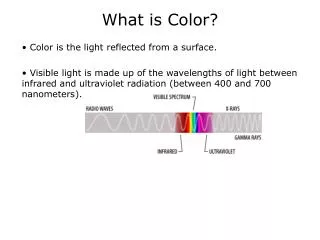
What is Color? • Color is the light reflected from a surface. • Visible light is made up of the wavelengths of light between infrared and ultraviolet radiation (between 400 and 700 nanometers).
Color Models Additive Model RGB, Light Subtractitive Model CMYK, Pigment
Additive Color Sergei Mikhailovich Prokudin-Gorskii. Dmitrievskii Church, 1911.
Describing Color Hue The ‘color’ of the color. Red, Orange, Yellow, Green, Blue, Indigo, Violet Value Lightness (tint) or darkness (shade) of a color. Saturation (Chroma) Intensity of the hue in the color. Desaturated colors tend to look gray.
Color Contrast Low Contrast High Contrast Contrast Of Hue Contrast Of Value Contrast Of Saturation
Newton’s Color Model A color circle, based on red, yellow and blue, is traditional in the field of art. Sir Isaac Newton developed the first circular diagram of colors in 1666. Graphics taken from www.colormatters.com
Primary Colors Primary colors are the most basic colors; they cannot be broken down into component colors. The primary colors are different depending on which color model you are using. The primary colors in the Newtonian color model are red, yellow, and blue. Graphics taken from www.colormatters.com
Secondary Colors These are the colors formed by mixing the primary colors. Graphics taken from www.colormatters.com
Tertiary Colors These are the colors formed by mixing one primary and one secondary color. Graphics taken from www.colormatters.com
Color Relationships Primary Colors Essential colors, cannot be broken down into component colors Secondary Colors Mixture of two primary colors Analogous Colors located close together on a color wheel. Complementary Colors Located opposite each other on a color wheel Newtonian (Artist’s) Color Wheel Monochromatic Colors Shades and tints of the same color Shade and Tint Add black or white Intensity Amount of saturation) Graphics taken from www.worqx.com/color
WARM COOL Color Temperature Temperature can be measured absolutely, or relatively. For example, yellow-green is warmer than cyan-green, but both are cool colors. An approximate separation of absolute color temperature is denoted below: Nearly any color could appear as either warm or cold depending on the surrounding colors, especially those near the dividing line.
Color Context Red appears more brilliant against a black background and somewhat duller against the white background. In contrast with orange, the red appears lifeless; in contrast with blue-green, it exhibits brilliance. Notice that the red square appears larger on black than on other background colors. Graphics taken from www.colormatters.com