Download
1 / 7
80 likes | 226 Vues
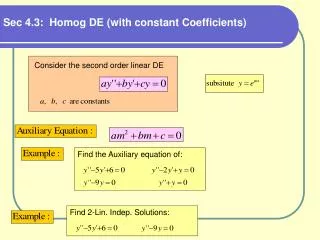
This guide outlines the methodical approach to solving homogeneous second order linear differential equations (DEs) with constant coefficients. It details the three main steps: first, finding the auxiliary equation; second, determining the roots of the equation; and third, deriving two linearly independent solutions based on the nature of the roots. The guide covers distinct real roots, repeated real roots, and complex conjugate roots with practical examples, including Euler's formula, to illuminate each case thoroughly.

E N D
Sec 4.3: Homog DE (with constant Coefficients) Consider the second order linear DE Find the Auxiliary equation of: Find 2-Lin. Indep. Solutions:
HOW ?? Method (2ed order DE with constant coeff) Given a homg DE: Step 1 Find the Auxiliary equation: Step 2 Find roots (distinct real) Step 3 Two Linearly Independent Solutions are: Find 2-Lin. Indep. Solutions: Find 2-Lin. Indep. Solutions:
Method (2ed order DE with constant coeff) Given a homg DE: Step 1 Find the Auxiliary equation: Step 2 Find roots Step 3 Three Cases: 2-distict real roots 2-repeated real roots 2- non-real roots Find 2-Lin. Indep. Solutions:
WHY??? Euler’s Formula Find the following:
Two Special Differential Equations Consider the second order linear DE Consider the second order linear DE
Method (Higher order DE with constant coeff) Given a homg DE: Step 1 Find the Auxiliary equation: Step 2 Find roots Step 3 We have combination of Four Cases: distict real roots : (r-times) repeated real roots: Conjugate non-real: repeated Conjugate non-real: (r-times) Solve:
Given that Is the general solution for a differential equation. Find this differential equation. Given that Is a solution to a homog DE with constant coeff Find a possible differential operator