Exploring Sudoku Orthogonality: The Puzzle Beyond Numbers
230 likes | 289 Vues
Investigate the concept of orthogonal Sudoku puzzles involving Latin squares and transversals, unveiling methods for orthogonal mates. Discover connections between block permutations and exponent arrays in Sudoku solutions.


Exploring Sudoku Orthogonality: The Puzzle Beyond Numbers
E N D
Presentation Transcript
Sudoku and Orthogonality John Lorch Undergraduate Colloquium Fall 2008
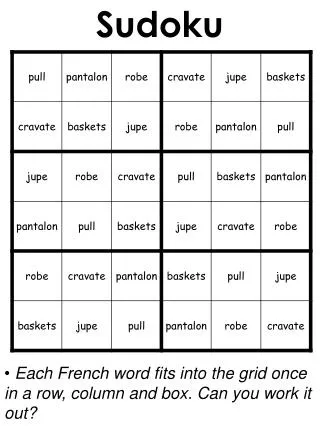
What is a sudoku puzzle? • Sudoku • ‘single number puzzle’ • numbers 1-9 must appear in every row, column, and block. • Typically appears in ordern2: An n2×n2 array with n×n blocks. Sudoku and Orthogonality: John Lorch
Sudoku solution • The completion of the previous puzzle: all entries are filled in. • A sudoku solution is a completed puzzle. Sudoku and Orthogonality: John Lorch
A latin squareof order n isan n×n array with n distinct symbols. Each symbol appears once in each row and column. Literature on latin squares dates to Euler (1782). Sudoku solution: a latin square with additional condition on blocks. Non-sudoku Latin square Sudoku Sudoku and Latin squares Sudoku and Orthogonality: John Lorch
Questions about sudoku • Natural questions: • How many sudoku solutions exist for a given order? • What is the minimum number of entries determining a unique completion? • What can symmetry groups tell us about sudoku? • What is known about orthogonal sudoku puzzles? • Our purpose: investigate orthogonality Sudoku and Orthogonality: John Lorch
Two latin squares are orthogonal if superimposition yields all possible ordered pairs of symbols. Orthogonality is preserved by Relabeling either square Rearrangement applied to both squares Orthogonal squares: Orthogonal Latin squares Sudoku and Orthogonality: John Lorch
Orthogonal sudoku mates • Golomb’s problem: (MAA Monthly 2006) Do there exist pairs of orthogonal sudoku solutions? • Answer: Yes • Our purpose, more specifically: • Investigate methods for producing such pairs. • Make observations on these methods. Sudoku and Orthogonality: John Lorch
Background: Transversals • Transversal: A collection of locations and corresponding entries so that each row, column, and symbol is represented exactly once. Sudoku and Orthogonality: John Lorch
Background: Transversals • Transversal Theorem: A latin square of order n has an orthogonal mate if and only if it has ndisjoint transversals. • Proof of theorem yields a method for producing an orthogonal mate. • Unfortunately, method fails to preserve sudoku block condition. Sudoku and Orthogonality: John Lorch
Method 1: Combing transversals • Consider an order 4 solution with transversal. To get orthogonal sudoku mate, we can’t apply transversal theorem directly. • Instead: Use transversals as rows (left to right combing) Sudoku and Orthogonality: John Lorch
Method 1: Combing transversals • Illustration of method with solution, yielding an orthogonal pair. Sudoku and Orthogonality: John Lorch
Method 1: Combing transversals • A different choice of transversal can yield non-orthogonal solutions: Sudoku and Orthogonality: John Lorch
Method 1: Combing transversals • Theorem: For a ‘block symmetric’ solution the combing method produces a sudoku solution. • Proof: • Rows have distinct symbols since transversals do. • Columns have distinct symbols since each (new) column is a permutation of the corresponding original column. • Blocks are rearranged and permuted, so still have distinct symbols in each block. Sudoku and Orthogonality: John Lorch
Method 1: Combing transversals Conjecture: Given a block symmetric sudoku solution, there is a choice of transversal for which the combing method produces an orthogonal sudoku mate. Sudoku and Orthogonality: John Lorch
Let α and β permute the rows and columns of block K, respectively, so that: Row i of Kα is row i+1 of K (cycle up) Column j of Kβ is column j+1 of K (cycle left) K Kα Kβ Method 2: Block Permutations Sudoku and Orthogonality: John Lorch
Method 2: Block Permutations • Theorem (Keedwell, 2007): Solutions and are orthogonal sudoku mates. One can extend the pattern to obtain orthogonal sudoku pairs of all square orders. Sudoku and Orthogonality: John Lorch
Method 2: Block permutations • Keedwell’s proof: Apply transversal theorem. Sudoku and Orthogonality: John Lorch
Another approach: Identify sudoku block locations with Zn2 Each Keedwell solution has an exponent array Exponent arrays are functions Zn2 Zn2 Z32 Method 2: Block permutations Sudoku and Orthogonality: John Lorch
Method 2: Block permutations • Theorems: • Two Keedwell sudoku solutions of order n2 are orthogonal if and only if the difference of their exponent arrays determines a bijection Zn2 Zn2 • The maximum size of an orthogonal family of sudoku solutions of order n2 is larger than or equal to p(p-1), where p is the smallest prime factor of n. Sudoku and Orthogonality: John Lorch
Applications and Connections • An easy proof of Keedwell’s Theorem: • Exponent arrays corresponding to Keedwell’s solutions are F1(i,j)=(i+j,j) and F2(i,j)=(i,i+j). Note (F2-F1)(i,j)=(-j,i) is a bijection Zn2 Zn2, so the original sudoku solutions are orthogonal.
Applications and Connections • Construction of 6 MOSu of order 9. M0 M1 M2 M3 M4 M5 Sudoku and Orthogonality: John Lorch
Applications and Connections • Observations • M1 can be achieved from M0 via combing (method 1); M2 achieved from M0 via another transversal method not discussed here. Can transversal methods be used to obtain other solutions in the collection? • Can also get 6 MOSu of order 9 by looking at the addition table for GF(9). In general, field theory and finite projective spaces can be used to determine results about orthogonality. Sudoku and Orthogonality: John Lorch
Collaborators/References • Joint with Lisa Mantini (Oklahoma State) • Principal references: • C. Colbourn and J. Dinitz, Mutually orthogonal latin squares, Journal of Statistical Planning and Inference 95 (2001), 9-48. • A. Keedwell, On sudoku squares, Bulletin of the ICA 50 (2007), 52-60. • J. Lorch, Mutually orthogonal families of linear sudoku solutions, preprint. http://www.cs.bsu.edu/homepages/jdlorch/lorchsudoku.pdf Sudoku and Orthogonality: John Lorch