
Consumer_Credit_2021
1) Report the crime to the police immediately. Get a copy ofthe police report or case number. Credit card companies,the bank, or insurance companies may ask for the reference to verify the crime.

Consumer_Credit_2021
E N D
Presentation Transcript
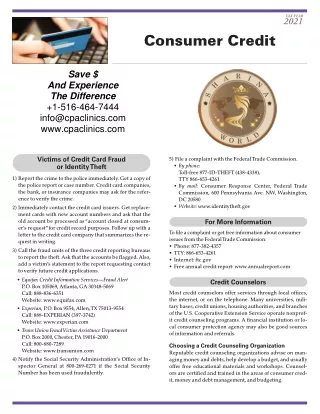
TAX YEAR 2021 Consumer Credit Save $ And Experience The Difference +1-516-464-7444 info@cpaclinics.com www.cpaclinics.com Victims of Credit Card Fraud or Identity Theft 5) File a complaint with the Federal Trade Commission. • By phone: Toll-free 877-ID-THEFT (438-4338), TTY 866-653-4261 • By mail: Consumer Response Center, Federal Trade Commission, 600 Pennsylvania Ave. NW, Washington, DC 20580 • Website: www.identitytheft.gov 1) Report the crime to the police immediately. Get a copy of the police report or case number. Credit card companies, the bank, or insurance companies may ask for the refer- ence to verify the crime. 2) Immediately contact the credit card issuers. Get replace- ment cards with new account numbers and ask that the old account be processed as “account closed at consum- er’s request” for credit record purposes. Follow up with a letter to the credit card company that summarizes the re- quest in writing. 3) Call the fraud units of the three credit reporting bureaus to report the theft. Ask that the accounts be flagged. Also, add a victim’s statement to the report requesting contact to verify future credit applications. • Equifax Credit Information Services—Fraud Alert P.O. Box 105069, Atlanta, GA 30348-5069 Call: 888-836-6351 Website: www.equifax.com • Experian, P.O. Box 9554, Allen, TX 75013-9554 Call: 888-EXPERIAN (397-3742) Website: www.experian.com • Trans Union Fraud Victim Assistance Department P.O. Box 2000, Chester, PA 19016-2000 Call: 800-680-7289 Website: www.transunion.com 4) Notify the Social Security Administration’s Office of In- spector General at 800-269-0271 if the Social Security Number has been used fraudulently. For More Information To file a complaint or get free information about consumer issues from the Federal Trade Commission: • Phone: 877-382-4357 • TTY: 866-653-4261 • Internet: ftc.gov • Free annual credit report: www.annualreport.com Credit Counselors Most credit counselors offer services through local offices, the internet, or on the telephone. Many universities, mili- tary bases, credit unions, housing authorities, and branches of the U.S. Cooperative Extension Service operate nonprof- it credit counseling programs. A financial institution or lo- cal consumer protection agency may also be good sources of information and referrals. Choosing a Credit Counseling Organization Reputable credit counseling organizations advise on man- aging money and debts, help develop a budget, and usually offer free educational materials and workshops. Counsel- ors are certified and trained in the areas of consumer cred- it, money and debt management, and budgeting.
Tip-Offs Be careful of debt negotiation companies that: • Guarantee they can remove unsecured debt. • Promise that unsecured debts can be paid off with pen- nies on the dollar. • Require substantial monthly service fees. • Demand payment of a percentage of savings. • Tell the individual to stop making payments or commu- nicating with creditors. • Require the individual to make monthly payments to them rather than the creditor. • Claim that creditors never sue consumers for non-pay- ment of unsecured debt. • Promise that using their system will have no negative im- pact on the individual’s credit report. • Claim that they can remove accurate negative informa- tion from the individual’s credit report. Consumer Credit Counselors discuss the person’s entire financial situation and help develop a personalized plan. A reputable credit counseling agency should send free information about the services it provides without requiring any details about the individual’s situation. If a firm doesn’t do that, consider it a red flag and go elsewhere for help. Check out potential credit counseling agencies with the state Attorney Gener- al, local consumer protection agency, and Better Business Bureau. Debt Management Plan (DMP) How a DMP Works Money is deposited each month with the credit counseling organization. The organization uses the deposits to pay un- secured debts, such as credit card bills, student loans, and medical bills, according to a planned payment schedule. Creditors may agree to lower interest rates and waive cer- tain fees, but check with all the creditors to be sure that they offer the concessions that a credit counseling organization describes. A successful DMP requires regular, timely pay- ments and could take 48 months or longer to complete. Avoid organizations that push a DMP as the only option before they do an analysis of the individual’s financial situation. Protect Yourself • Never provide personal financial information over the phone or internet if you did not initiate the contact. Instead, call the company yourself for verification. • Do not be intimidated by an email or phone call. Any communication suggesting dire consequences for fail- ing to provide or verify financial information should be ignored. • Review account statements regularly to ensure all charges are correct. If your account statement is late in arriving, contact the lending institution immediately. • Don’t fall for an IRS imposter. The IRS does not call or send out unsolicited emails asking for personal information. Debt Negotiation Programs Debt negotiation is not the same thing as credit counseling or a DMP. It can be risky and have a negative impact on the individual’s credit report. Many states have laws regulat- ing debt negotiation companies and the services they offer. Just because a debt negotiation company describes itself as a “nonprofit” organization, there’s no guarantee that the ser- vices offered are legitimate. Most debt negotiation compa- nies charge consumers substantial fees for their services, in- cluding a fee to establish the account with the debt negoti- ator, a monthly service fee, and a final fee of a percentage of the money supposedly saved. Contact Us There are many events that occur during the year that can affect your tax situation. Preparation of your tax return involves sum- marizing transactions and events that occurred during the prior year. In most situations, treatment is firmly established at the time the transaction occurs. However, negative tax effects can be avoided by proper planning. Please contact us in advance if you have questions about the tax effects of a transaction or event, including the following: • Pension or IRA distributions. • Significant change in income or deductions. • Job change. • Marriage. • Attainment of age 59½ or 72. • Sale or purchase of a business. • Sale or purchase of a residence or other real estate. • Retirement. • Notice from IRS or other revenue department. • Divorce or separation. • Self-employment. • Charitable contributions of property in excess of $5,000. This brochure contains general information for taxpayers and should not be relied upon as the only source of authority. Taxpayers should seek professional tax advice for more information. Copyright © 2021 Tax Materials, Inc. All Rights Reserved Powered by TCPDF (www.tcpdf.org)