
Dependent_Support_Worksheet_2021
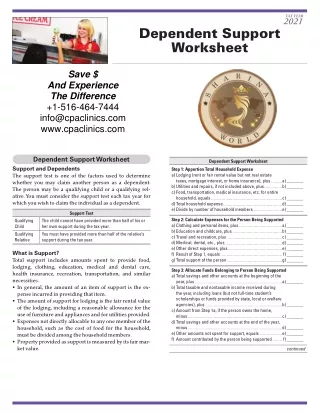
The support test is one of the factors used to determine whether you may claim another person as a dependent. The person may be a qualifying child or a qualifying relative. You must consider the support test each tax year for which you wish to claim the individual as a dependent.

Dependent_Support_Worksheet_2021
E N D
Presentation Transcript
TAX YEAR 2021 Dependent Support Worksheet Save $ And Experience The Difference +1-516-464-7444 info@cpaclinics.com www.cpaclinics.com Dependent Support Worksheet Support and Dependents The support test is one of the factors used to determine whether you may claim another person as a dependent. The person may be a qualifying child or a qualifying rel- ative. You must consider the support test each tax year for which you wish to claim the individual as a dependent. Dependent Support Worksheet Step 1: Apportion Total Household Expense a) Lodging (rent or fair rental value but not real estate taxes, mortgage interest, or home insurance), plus .........a) _______ b) Utilities and repairs, if not included above, plus ...............b) _______ c) Food, transportation, medical insurance, etc. for entire household, equals ............................................................c) _______ d) Total household expense. .................................................d) _______ e) Divide by number of household members .........................e) _______ Support Test Step 2: Calculate Expenses for the Person Being Supported a) Clothing and personal items, plus .....................................a) _______ b) Education and childcare, plus ..........................................b) _______ c) Travel and recreation, plus ..............................................c) _______ d) Medical, dental, etc., plus.................................................d) _______ e) Other direct expenses, plus ..............................................e) _______ f) Result of Step 1, equals .................................................... f) _______ g) Total support of the person ...............................................g) _______ Qualifying Child Qualifying Relative The child cannot have provided more than half of his or her own support during the tax year. You must have provided more than half of the relative’s support during the tax year. What is Support? Total support includes amounts spent to provide food, lodging, clothing, education, medical and dental care, health insurance, recreation, transportation, and similar necessities. • In general, the amount of an item of support is the ex- pense incurred in providing that item. • The amount of support for lodging is the fair rental value of the lodging, including a reasonable allowance for the use of furniture and appliances and for utilities provided. • Expenses not directly allocable to any one member of the household, such as the cost of food for the household, must be divided among the household members. • Property provided as support is measured by its fair mar- ket value. Step 3: Allocate Funds Belonging to Person Being Supported a) Total savings and other accounts at the beginning of the year, plus ..........................................................................a) _______ b) Total taxable and nontaxable income received during the year, including loans (but not full-time student’s scholarships or funds provided by state, local or welfare agencies), plus .................................................................b) _______ c) Amount from Step 1a, if the person owns the home, minus ................................................................................c) _______ d) Total savings and other accounts at the end of the year, minus ................................................................................d) _______ e) Other amounts not spent for support, equals ...................e) _______ f) Amount contributed by the person being supported ........ f) _______ continued
Item Included in Total Support? continued Student loan proceeds used for current school or living expenses Student loan proceeds left in the bank for use in a future year Value of car you own Operating costs allocated to the other person’s use of your car Computer used by entire household Computer purchased as a gift for the other person Clothing purchased by the other person with his or her savings Wages earned by the other person but spent on someone else Social Security payments received but not spent by the other person Your 16-year-old son’s trip to Mexico, financed by the liquidation of his college trust fund Inherited money left in a trust fund Yes X No Dependent Support Worksheet X X Dependent Support Worksheet continued Step 4: Determine Who Provided More Than Half of the Person’s Support a) Amount others contributed to the person’s support, including state, local, and welfare agencies, but none of the amounts used in Step 3........................................... a) _______ b) Amount you provided for the person’s support. This should equal the result of Step 2 (total support), minus the result of Step 3 (amount the person contributed), minus 4a (amount others contributed) .............................. b) _______ X X X X X X Is the result of Step 3 (amount the person contributed) less than or equal to 50% of the result of Step 2 (half of total support)? • If yes, then the person meets the support test for a qualifying child. • If no, then the person provided more than half of his or her own support and you cannot claim the him or her as a dependent. Is the amount you contributed more than 50% of the result of Step 3 (half of total support)? • If yes, then the person meets the support test for a qualifying relative. • If no, then you cannot claim the person as a dependent unless you can do so under a multiple support agreement, the support test for children of divorced or separated parents, or the special rule for kidnapped children. X X Considered Provided By You? Payments you receive from a placement agency, state, or county for support of a foster child Unreimbursed foster care expenses ineligible for charitable contribution deduction, and you are not in the foster care business Dependency allotments taken out of your military pay or contributed by the government Wages you pay to a child Social Security benefits payable to the child or relative Welfare benefits and food stamps you receive Your earnings, tax-exempt income, savings, or borrowed money that you spend on a child or relative Yes No X X When Should You Include Support Items? A qualifying item is included in total support in the year it is paid. This is true even if you paid for the item with bor- rowed money that you repay in a later year. X X X X Item Included in Total Support? Life insurance premiums you paid on another person’s life Funeral expenses you paid Amounts you paid for childcare Dependent care or medical expenses paid out of your FSA or HSA Survivors’ and Dependents’ Educational Assistance payments used for the support of the recipient Income and FICA taxes paid on the person’s own earnings GI Bill payments and allowances received by the person Part-time student’s scholarship Full-time student’s scholarship Yes No X X X X X X X Contact Us X X There are many events that occur during the year that can affect your tax situation. Preparation of your tax return involves sum- marizing transactions and events that occurred during the prior year. In most situations, treatment is firmly established at the time the transaction occurs. However, negative tax effects can be avoided by proper planning. Please contact us in advance if you have questions about the tax effects of a transaction or event, including the following: • Pension or IRA distributions. • Significant change in income or deductions. • Job change. • Marriage. • Attainment of age 59½ or 72. • Sale or purchase of a business. • Sale or purchase of a residence or other real estate. X • Retirement. • Notice from IRS or other revenue department. • Divorce or separation. • Self-employment. • Charitable contributions of property in excess of $5,000. This brochure contains general information for taxpayers and should not be relied upon as the only source of authority. Taxpayers should seek professional tax advice for more information. Copyright © 2021 Tax Materials, Inc. All Rights Reserved Powered by TCPDF (www.tcpdf.org)
