Contiguity and Contingency Theories in Learning Experiments
Exploring the impact of pairings on learning through Contiguity and Contingency theories in psychology experiments. Learn about predictive probabilities and implications for control groups.

Contiguity and Contingency Theories in Learning Experiments
E N D
Presentation Transcript
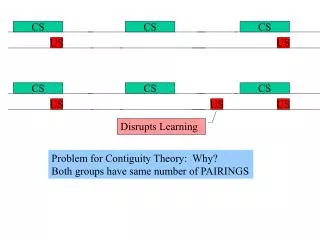
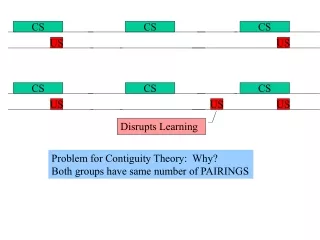
CS CS CS CS CS CS US US US US US Disrupts Learning Problem for Contiguity Theory: Why? Both groups have same number of PAIRINGS
Probability of a US given that a CS has occurred Contiguity: the more pairings, the more learning Contingency: How PREDICTIVE is the CS? TWO Probabilities are important: 1. How likely is it that the US will occur when the CS is presented? P(US/CS) e.g., 4 out of 10 CS presentations followed by a US P(US/CS) = 0.4
Contiguity: the more pairing, the more learning Contingency: How PREDICTIVE is the CS? TWO Probabilities are important: 1. How likely is it that the US will occur when the CS is presented? P(US/CS) 2. How likely is it that the US will occur when CS is NOT presented ? P(US/noCS)
Rescorla P(US/CS) = ? 0.4 (for all groups) CS CS CS CS CS US US US US For different groups: P(US/noCS) = 0 0.1 0.2 0.4
1.0 0 0 1.0 Contingency Space P(US/CS) > P(US/noCS) Excitatory conditioning P(US/CS) = P(US/noCS) Random P(US/CS) P(US/CS) < P(US/noCS) Conditioned Inhibition P(US/noCS)
Discrimination Training (Conditioned Inhibition) A-US B- A 1.0 A? P(US/CS) = 1 A? P(US/CS) = ? P(US/noCS) = ? P(US/noCS) = 0 P(US/CS) B? P(US/CS) = ? B? P(US/CS) = 0 0 B P(US/noCS) = ? P(US/noCS) > 0 0 P(US/noCS) 1.0
It doesn’t need to be “perfect” discrimination training: 1.0 P(US/CS) > P(US/noCS) Excitatory conditioning P(US/CS) = P(US/noCS) Random P(US/CS) P(US/CS) < P(US/noCS) Conditioned Inhibition 0 0 1.0 P(US/noCS)
Implications for Control groups: 1.0 Interaction Effect? CS-US unpaired P(US/CS) = P(US/noCS) Random Where would UNPAIRED lie in Contingency Space? P(US/CS) So….Unpaired is poor control group Conditioned Inhibition 0 P(US/noCS) 0 1.0 Better Control for interaction effect? Random: Neither Excitatory nor Inhibitory Conditioning (i.e., no learning?)