OSCE Data interpretation stations
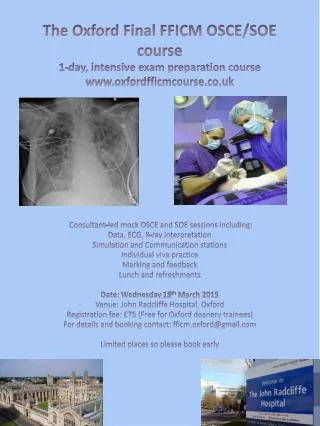
This guide outlines essential objectives and formats for OSCE data interpretation stations, led by Dr. Cathy Armstrong, Consultant Anaesthetist. It covers critical components such as blood tests, ECG, radiology, and observations, emphasizing effective communication during assessments. Key tips include efficient use of thinking time, succinct language, and presenting clear reasoning. Learn to recognize normal and abnormal findings, develop differential diagnoses, and manage initial treatment steps. Enhance your clinical skills with structured guidance to excel in examinations.

OSCE Data interpretation stations
E N D
Presentation Transcript
OSCE Data interpretation stations Dr Cathy Armstrong Consultant Anaesthetist Dec 2014
Objectives • The stations • Format • Tips • Blood tests • Patterns to look for • examples
Format • Instructions • Brief background • Study data – ‘after 5 minutes the examiner will ask you some questions on diagnosis & initial management’
Format • Data • Blood tests • ECG • CXR • Observations
Format • Questions from examiner • Structured / standardised • ‘what do the blood tests show?’ • ‘what does the CXR show?’ • What is your most likely diagnosis? What is your top differential? • What will your initial management be?
Tips • Use your thinking time wisely • Use succinct language & be confident • Likely to be some normal investigations also • Show reasoning behind your thoughts • Flag up potential dangers
Tips • Differential diagnosis • Start with your top & why • Initial management • Might include oxygen / fluids / nebulisers • Remember management packages – e.g septic 6 • Further detailed history • Other definitive investigations – e.g.echo, CT • Don’t forget SENIOR HELP / INPUT
Full Blood Count • Hb • Males 135 – 180g/l • Females 115 – 160 g/l • WCC • 4.0 – 11 x 109/l • Platelets • 150 – 400 x 109/l
Anaemia classification by MCV MCV – mean cell volume (76 – 96 fl) • Normal MCV (Normocytic) • Acute blood loss • Anaemia of chronic disease • Low MCV (microcytic) • Iron deficiency • Thalassaemia • High MCV (Macrocytic) • B12 or folate deficiency
High wcc - neutrophilia • Raised WCC most commonly due to neutrophilia • Neutrophils account for 40 – 75% of WBC • recognise & ingest foreign particles & microorganisms • Causes of neutrophilia • Infection • Trauma • Infarction • Inflammation • Malignancy • Myeloproliferative disease • Physiological (exercise & pregnancy)
Low wcc - neutropenia • Most commonly caused by neutropenia • Causes of neutropenia • Infection • Drugs • Autoimmune • Alcohol • congenital
Thrombocytosis • Reactive • Chronic inflammatory disorders • Malignant disease • Post-haemorrhage • Post-splenectomy • Haemolytic anaemias • Malignant • Essential thrombocythaemia • Polycythaemia rubra vera • myelofibrosis
Thrombocytopenia • Marrow disorders • Hypoplasia – idiopathic, drug-induced • Infiltration • Leukaemia, Myeloma, Carcinoma, Myelofibrosis • B12 / folated deficiency • Increased consumption of platelets • DIC, ITP, viral infections, bacterial infections • Hypersplenism • Lymphoma, liver disease
Urea & electrolytes • Na 135-145 mmol/l • K 3.5 – 5.5 mmol/l • Ur 2.5 – 6.7 mmol/l • Cr 70 – 150 mmol/l
Hyperkalaemia • Mild 5.5 - 6.0 mmol/l • Mod 6.1 – 7.0 mmol/l • Severe > 7.0 mmol/l • Causes • ↑ intake • Food ingestion / supplements • Rapid blood transfusion • Intercompartmental shifts • Trauma / crush injuries • Burns • Acidosis • Decreased excretion • Acute / chronic renal failure • Adrenocortical insufficiency (e.g. Addisons disease) • Medications • Potassium sparing diuretics, digoxin
Hyperkalaemia • ECG changes • Peaked T waves • Prolonged PR interval • Widened QRS • Loss of P wave • Loss of R wave amplitude • Sine wave pattern • Asystole • Management of mod / severe • Treat underlying cause • Calcium gluconate • Insulin dextrose infusion • Nebulised salbutamol • dialysis
Hypokalaemia • Mild 3.0 – 3.5 mmol/l • Mod 2.5 – 3.0 mmol/l • Severe < 2.5 mmol/l • Causes • ↓ intake • Iatrogenic (no K in IV fluids) • Malnutrition • Renal losses • Renal tubular acidosis • Hyperaldosteronism (Conn’s syndrome) • GI losses • Diarrhoea, vomiting • Intercompartmental shifts • insulin • Alkalosis • Medications • Diuretics, β2 agonists
Hypernatraemia • Usually due to water loss in excess of sodium loss • Causes include: • Iatrogenic (too much IV N saline) • Diabetes Insipidus • Primary aldosteronism (Conn’s Syndrome)
Diseases with electrolyte patterns • Addisons disease (Primary adrenocortical insufficiency) • Na K Ca • Cushings syndrome (excess plasma cortisol) • Na K Ca • Conn’s Syndrome (hyperaldosteronism) • Na K
Diseases with electrolyte patterns • Addisons disease (Primary adrenocortical insufficiency) • Na ↓ K ↑ Ca ↑ • Cushings syndrome (excess plasma cortisol) • Na ↑ K ↓ Ca ↓ • Conn’s Syndrome (hyperaldosteronism) • Na ↑ ↔ K ↓
Raised Urea & creatinine • Both raised in renal failure • Alternative causes of a raised urea with relatively normal Cr • Dehydration • GI haemhorrhage • High protein diet
Deciphering between acute & chronic renal failure using blood results • Chronic renal failure • Anaemia of chronic disease • Low calcium • High phosphate
Liver Function tests Non-specific Bilirubin AST (Aspartate transaminase) ALP (Alkaline phophatase) γ – GT (Gamma –glutamyl transpeptidase) Albumin Specific ALT (Alanine aminotransferase)
LFT patterns • Hepatocellular Damage • Large ↑ in ALT with small ↑ in ALP • Biliary obstruction • Small ↑ ALT with large ↑ in ALP & γ -GT
Areas not covered • Clotting studies • Anticoagulant monitoring • CRP • Blood cultures • Specialist tests • E.g – vasculitis screens / immunology
Normal ABG Values 7.35 - 7.45 10-12 kPa 4.5 - 6.0 kPa 22 – 26 mmol/l -2 - +2 mmol/l pH PaO2 PaCO2 HCO3 Base Excess IN AIR Many modern gas machines also measure K+ Na+ Cl- SaO2 Hb COHb MetHb Lactate
Expected PO2 on oxygen % oxygen – 10
Ryan • Ryan is a 17 year old male. He has presented to A&E with a 2 month history of general malaise. Over the past few days he has been vomiting with stomach cramps. • BP 110/70, Apyrexial, RR 39 • Review the investigations provided. You will then be asked questions on diagnosis and initial management.
Hb 12.9 (9.0 – 13.0) Wcc 7.0 (4.0 – 11.0) Plt 395 (150-400) Na 139 (135-145) K 4.5 (3.5-5.5) Ur 15.0 (3.3-6.6) Cr 140 (80-120) Blood glucose 35mmol/l ABG on air pH 7.12 (7.35-7.45) PCo2 3.0 (4.5-6.0) PO2 11.0 (10-12 in air) HCO3 17 (22-26) BE -23 (-2- +2) Ryan
Jack • Jack is a 77 year old male. He has presented to A&E with a 2 day history of abdominal pain and vomiting. • BP 90/45, T 38.5. RR 30 • Examination of the abdomen reveals a hard abdomen with generalised tenderness and guarding • Review the investigations provided. You will then be asked questions on diagnosis and initial management.
Hb 9.0 (9.0 – 13.0) Wcc 22.3 (4.0 – 11.0) Plt 170 (150-400) Na 139 (135-145) K 4.5 (3.5-5.5) Ur 10.0 (3.3-6.6) Cr 130 (80-120) ABG on air pH 7.22 (7.35-7.45) PCo2 6.1 (4.5-6.0) PO2 7.5 (10-12 in air) HCO3 18 (22-26) BE -10 (-2- +2) Jack
Dorothy • Dorothy is a 82 year old female. She has presented to A&E with a 5 day history of productive cough with green sputum and worsening shortness of breath. • BP 93/50, T 38.5. RR 32 • Review the investigations provided. You will then be asked questions on diagnosis and initial management.
Hb 11.0 (9.0 – 13.0) Wcc 21.0 (4.0 – 11.0) Plt 250 (150-400) Na 139 (135-145) K 4.5 (3.5-5.5) Ur 8.0 (3.3-6.6) Cr 90 (80-120) ABG on 60% oxygen pH 7.35 (7.35-7.45) PCo2 4.2 (4.5-6.0) PO2 13 (10-12 in air) HCO3 23 (22-26) BE -3 (-2- +2) Dorothy
CURB 65 • Confusion • Urea – 7.0 or over • RR 30 or over • BP • Systolic 90 or less OR • Diastolic 60 or less • Age 65 or over
Sepsis 6 • Oxygen • Blood cultures • IV antibiotics • Lactate & FBC • IV fluids • Measure UO
Tom • Tom is a 22 year old male. He has presented to A&E with shortness of breath and an audible wheeze • BP 135/90, T 36.5. RR 38 • Review the investigations provided. You will then be asked questions on diagnosis and initial management.
Hb 11.0 (9.0 – 13.0) Wcc 6.0 (4.0 – 11.0) Plt 250 (150-400) Na 139 (135-145) K 4.5 (3.5-5.5) Ur 5.9 (3.3-6.6) Cr 80 (80-120) ABG on 15L oxygen via non-rebreath mask pH 7.32 (7.35-7.45) PCo2 5.9 (4.5-6.0) PO2 9 (10-12 in air) HCO3 23 (22-26) BE -3 (-2- +2) Tom
summary • Read instructions carefully • Take time to look at data, formulate a differential diagnosis & initial management plan • Be confident in your approach • Remember senior input