Algorithms (2IL15) – Lecture 11 Approximation Algorithms
Dive into the world of approximation algorithms for NP-complete problems, exploring terminology, heuristics, and proven examples like Vertex Cover. Learn how to prove the quality of the solution compared to the optimal and implement these algorithms effectively.

Algorithms (2IL15) – Lecture 11 Approximation Algorithms
E N D
Presentation Transcript
Algorithms (2IL15) – Lecture 11 Approximation Algorithms
NP-complete problems: problems A in NP such that B ≤P A for any B in NP Examples: Circuit-Sat, SATISFIABILITY, 3-SAT, CLIQUE, VertexCover, Subset Sum, Hamiltonian Cycle, … NP-complete problems cannot be solved in polynomial time, unless P = NP What to do when you want to solve an NP-complete (optimization) problem ? • still use exact algorithm:algorithm guaranteed to compute optimal solution will not be polynomial-time, but perhaps fast enough for some instances • heuristic: algorithm without guarantees on the quality of the solution • approximation algorithm:algorithm that computes solution whose quality is guaranteed to be within a certain factor from OPT
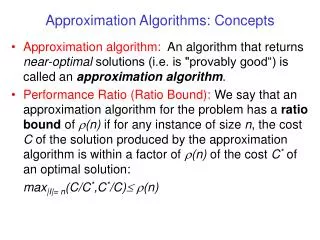
approximation factor Approximation algorithms: terminology Consider minimization problem OPT(I) = value of optimal solution for problem instance I ALG(I) = value of solution computed by algorithm ALG for problem instance I ALG is ρ–approximation algorithm if ALG(I) ≤ ρ ∙ OPT(I) for all inputs I Note: ρ can be a function of input size n (e.g.: O(log n)-approximation) Example: Vertex Cover if ALG computes, for any graph G, a cover with at most twice the minimum number of nodes in any vertex cover for G, then ALG is 2-approximation
maximization ALG(I) ≥ (1/ρ) ∙ OPT(I) Approximation algorithms: terminology (cont’d) Consider minimization problem OPT(I) = value of optimal solution for problem instance I ALG(I) = value of solution computed by algorithm ALG ALG is ρ–approximation algorithm if ALG(I) ≤ ρ ∙ OPT(I) for all inputs I Example: CLIQUE if ALG computes, for any graph G, a clique with at least half the maximum number of nodes in any clique in G, then ALG is 2-approximation. NB In the literature, one often talks about (1/ρ)-approximation instead of ρ-approximation for maximization problems. In example, ALG would be (1/2)-approximation algorithm.
For ρ-approximation algorithm ALG (for minimization problem) we must • describe algorithm … • … and analyze running time … • … and prove that ALG(I) ≤ ρ ∙ OPT(I) for all inputs I How can we prove that ALG(I) ≤ ρ ∙ OPT(I) if we don’t know OPT ?! we need to prove alower boundon OPT(I) Example: OPT(I) ≥ 100 ALG(I) ≤ 2 OPT(I) ALG(I) ≤ 200 for maximization problems we need upper bound
∩ G = (V,E) is undirected graph vertex cover in G: subset C V such that for each edge (u,v) in E we have u in C or v in C (or both) Vertex Cover (optimization version) Input: undirected graph G = (V,E) Problem: compute vertex cover for G with minimum number of vertices Vertex Cover is NP-hard.
An approximation algorithm for Vertex Cover: first attempt Approx(?)-Vertex-Cover (G) • C ← empty set; E* ← E // E* = set of edges not covered by C • whileE* not empty • do take edge (u,v) in E* • C ← C U {u } • remove from E* all edges that have u as an endpoint • return C
Does Approx(?)_Vertex-Cover have good approximation ratio? No: if we pick the wrong vertices, approximation ratio can be |V|−1 Second attempt:greedy • always pick vertex that covers largest number of uncovered edges • gives O(log |V|)-approximation algorithm: better, but still not so good
and/or v An approximation algorithm for Vertex Cover: third attempt Approx(?)-Vertex-Cover (G) • C ← empty set; E* ← E // E* = set of edges not covered by C • whileE* not empty • do take edge (u,v) in E* • C ← CU {u } • remove from E* all edges that have u as an endpoint • returnC {u,v}
U Approx-Vertex-Cover (G) • C ← empty set; E* ← E // E* = set of edges not covered by C • whileE* not empty • do take edge (u,v) in E* • C ← CU {u,v} • remove from E* all edges that have u and/or v as an endpoint • returnC Proving approximation ratio, step 1: try to get lower bound on OPT two edges are non-adjacent if they do not have an endpoint in common Lemma. Let N E be any set of non-adjacent edges. Then OPT ≥ |N |.
// N ← empty set Approx-Vertex-Cover (G) • C ← empty set; E* ← E // E* = set of edges not covered by C • whileE* not empty • do take edge (u,v) in E* • C ← CU {u,v} • remove from E* all edges that have u and/or v as an endpoint • returnC // N ← NU { (u,v) } • Theorem. Approx-Vertex-Cover is 2-approximation algorithm • and can be implemented to run in O( |V | + |E | ) time. • Proof (of approximation ratio). Consider any input graph G. • Let N be set of edges selected in step 3 during the algorithm. • N is set of non-adjacent edges, so OPT(G) ≥ |N | • |C | = 2 |N | Hence, ALG(G) = |C| = 2 |N | ≤ 2 OPT(G).
1 Θ(log |V| ) Theorem. Approx-Vertex-Cover is 2-approximation algorithm and can be implemented to run in O( |V | + |E | ) time. Can we do better? (1.5)-approximation, or (1.1)-approximation, or … ?) Slightly better algorithm is known: approximation ratio 2 − Theorem. No polynomial-time (1.3606)-approximation algorithm exists for Vertex Cover unless P = NP. but some other problems can be approximated much better …
33 33 17 17 8 8 MST versus TSP 15 15 Min Spanning Tree Input: weighted graph Output: minimum-weight tree connecting all nodes greedy:O( |E| + |V | log |V | ) Traveling Salesman (TSP) Input: complete weighted graph (non-negative edge weights) Output: minimum-weight tour connecting all nodes NP-complete what about approximation algorithm ?
v u w Lemma. MST is lower bound: for any graph G, we have TSP(G) ≥ MST(G). Triangle inequality: weight(u,w) ≤ weight(u,v) + weight(v,w) for any three vertices u,v,w A simple 2-approximation for TSP with triangle inequality Approx-TSP • Compute MST on G. • Double each edge of MST to get a cycle. • Take shortcuts to get a tour visiting every vertex exactly once.
G: Hardness of approximation of TSP without triangle inequality Theorem. Let ρ ≥ 1 be any constant. Then there cannot be a polynomial-time ρ-approximation algorithm for general TSP, unless P = NP. even for positive edge weights 1 G*: old edges weight 0 new edges: weight 1 ρ∙|V| + 1 |V| G has Hamiltonian cycle iff G* has tour of length 0 ρ-approx algorithm computes tour T with length(T) ≤ ρ∙ OPT = 0 ρ∙|V| and such a tour can only use edges of length 1
FPTAS notFPTAS Polynomial-time approximation schemes Consider minimization problem. A polynomial-time approximation scheme (PTAS) is an algorithm ALG with two parameters, an input instance I and a number ε > 0, such that: • ALG(I, ε) ≤ (1+ ε) ∙ OPT(I) (so it’s (1+ ε)-approximation algorithm) • running time of ALG is polynomial in n for any constant ε>0. Example of possible running times: O(n2 / ε5 ), O(21/ε n log n), O( n 3/ε), etc. FPTAS = fully polynomial-time approximation scheme = PTAS with running time not only polynomial in n, but also in 1/ε
maximization ≥ 1/(1+ε) FPTAS notFPTAS Polynomial-time approximation schemes Consider minimization problem. A polynomial-time approximation scheme (PTAS) is an algorithm ALG with two parameters, an input instance I and a number ε > 0, such that: • ALG(I, ε) ≤ (1+ ε) ∙ OPT(I) (so it’s (1+ ε)-approximation algorithm) • running time of ALG is polynomial in n for any constant ε>0. Example of possible running times: O(n2 / ε5 ), O(21/ε n log n), O( n 3/ε), etc. FPTAS = fully polynomial-time approximation scheme = PTAS with running time not only polynomial in n, but also in 1/ε
Subset Sum (optimization version) “Find maximum load for a truck, under the condition that the load does not exceed a given weight limit for the truck.” Input: multi-set X of non-negative integers, non-negative integer t Problem: compute subset S that maximizes ∑x in Sx under the condition that ∑x in Sx ≤ t ? Example: X = { 3, 5, 7, 10, 16, 23, 41 } t = 50 S = { 3, 5, 41} gives sum 49, which is optimal For simplicity we will only compute value of optimal solution, not solution itself.
An exponential-time exact algorithm for Subset Sum Use backtracking: generate all subset sums that are at most t Exact-Subset-Sum (X, t ) • L ← Generate-Subset-Sums (X, t) • return the maximum sum in L
Generating subset sums • X = { x1, x2, …, xn } • choices: do we take x1 into subset ? do we take x2 into subset ? ETC Define Li = { all possible sums you can make with x1,…,xi } Example: X = 2, 7, 5 L0 = { 0 } L1 = { 0 } U {0+2} = {0, 2} // for each sum in L0, we can add x1 to it or not L2 = {0, 2} U {0+7, 2+7} = {0, 2, 7, 9} L3 = {0,2,7,9} U {0+5, 2+5, 7+5, 9+5} = {0, 2, 5, 7, 9, 12, 14}
Generating subset sums • X = { x1, x2, …, xn } • choices: do we take x1 into subset ? do we take x2 into subset ? ETC Generate-Subsets ( X,t ) • L0 ← { 0 } • fori ←1 to n • do Copy Li-1 to list Mi-1 • Add xito each number in Mi-1 and remove numbers larger than t • Li ← Li-1UMi-1 • Remove duplicates from Li • returnLn running time: Ω (size of list Ln ) = Ω( 2n)
if we keep only one of them, we make only a small mistake when exactly can we afford to do this ? which one ? Turning the exponential-time exact algorithm into an FPTAS Speeding up the algorithm: don’t keep all numbers in Li( trim Li) Li = 0, 104, 134, 135, 145, 149, 204, 207, 224, 300 if numbers y and z in Li are almost the same, then throw away one of them safer to keep the smaller number, let’s say z throw away y when 1≤y / z ≤ 1 + δ for a suitable parameter δ
Trim ( L, δ ) // L is a sorted list with elements z0, z1, z2, … , zm (in order) NB z0 = 0 • last ←z1 • for j ← 2 to m • do if zj / last≤ 1+δ • then remove zj from L // trim • else last ← zj // don’t trim Generate-Trimmed-Subsets ( X,t ) • L0 ← empty set • fori ←1 to n • do Copy Li-1 to list Mi-1 • Add xito each number in Mi-1 and remove numbers larger than t • Li ← Li-1UMi-1 • Remove duplicates from Li • returnLn Trim (Li, δ )
Lemma. The size of any list Li is O( (1/δ) ∙ log t ) ) Proof. Let L = z0, z1, z2, … , zm (in order). Then zj/ zj-1 ≥ 1+δ, so zm ≥ (1+δ) ∙ zm-1 ≥ (1+δ) 2 ∙ zm-2 ≥ … ≥ (1+δ) m-1 ∙ z1 ≥ (1+δ) m-1 Hence, (1+δ) m-1 ≤ zm ≤ t, so (m -1) ∙ log (1+δ) ≤ log t Conclusion: m = O( (1/δ) ∙ log t ) ) since log(1+ δ) ≈ δ for smallδ
Lemma. If we choose δ = ε/(2n), then approximation ratio is 1+ ε. Proof.Li = list we maintain Ui = list we would maintain if we would never do any trimming Claim: For any y in Ui there is z in Li such thatz ≤ y ≤ (1+δ)i ∙ z Proof of Claim. By induction. OPT = value of optimal solution. Then OPT is max number in Un, so there is z in Li with z ≥ ( 1 / (1+δ)n ) ∙ OPT = ( 1 / (1+ ε/(2n))n ) ∙ OPT ≥ ( 1 / (1+ ε) ) ∙ OPT
Lemma. If we choose δ = ε/(2n), then approximation ratio is 1+ ε. Lemma. The size of any list Li is O( (1/δ) ∙ log t ) ). Plug in δ = ε/(2n): size of Li is O( (n/ε) ∙ log t ) ) Need log t bits to represent t size of Li polynomial in input size and 1/ε Running time is O ( Σi |Li | ) running time polynomial in input size and 1/ε Theorem. There is an FPTAS for the Subset Sum optimization problem.
Summary • ρ-approximation algorithm: algorithm for which computed solution is within factor ρ from OPT • to prove approximation ratio we usually need lower bound on OPT (or, for maximization, upper bound) • PTAS = polynomial-time approximation scheme = algorithm with two parameters, input instance and ε > 0, such that • approximation ratio is1+ ε • running time is polynomial in n for constant ε • FPTAS = PTAS whose running time is polynomial in 1/ ε • some problems are even hard to approximate