Journey Through the Solar System: Discoveries from NASA’s Spacecraft and Probes
180 likes | 303 Vues
Explore the wonders of our Solar System through stunning images and data collected by NASA's spacecraft. From the turbulent storms on Saturn's moon Enceladus to the mesmerizing lakes and dunes of Titan, this collection highlights groundbreaking discoveries made by missions like Voyager 2 and Huygens Probe. Delve into the unique features of Uranus and Neptune, including Uranus's sideways rotation and Neptune's dynamic atmosphere. Join us on this visual tour, showcasing the beauty and complexity of planets and their moons, including the dwarf planet Pluto and its companions.


Journey Through the Solar System: Discoveries from NASA’s Spacecraft and Probes
E N D
Presentation Transcript
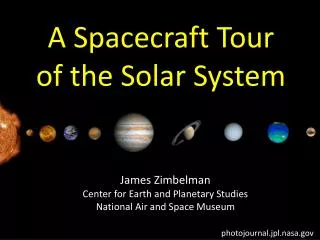
A Spacecraft Tour of the Solar System James Zimbelman Center for Earth and Planetary Studies National Air and Space Museum photojournal.jpl.nasa.gov
A new storm PIA12824 (12/24/10) PIA12826 (2/25/11)
Nature’s Canvas PIA06142 (11/7/04)
False-color mosaic Enceladus (512 km) “Tiger Stripes” PIA06254 (7/14/05) PIA06247
Fountains of Water-Ice from the “Tiger Stripes” PIA07758 & 9 (released 12/6/05) PIA14858 (10/1/11)
Titan (5210 km) D = 1.5M PIA06141 (10/26/04)
Lakes and Sand Dunes (radar images of Titan) Liquid Methane Lakes Longitudinal Dunes PIA08740 (9/23/06) (frame ~60 km wide) PIA08738 (9/7/06)
PIA07231 Huygens Probe (1/14/05) PIA07232
Uranus Diam. ~4.0E The planet that rotates on its side! (Poles: 42 yr sunlight, 42 yr darkness) Voyager 2 (9/86)
Uranus, rings, and satellites (HST) “Sheparding” satellites Voyager 2 (9/86)
Miranda (480 km) Miranda cliff -> (16 km high!) Arial (1162 km) Voyager 2 (9/86)
Neptune Diam. ~3.9E The ‘other’ Blue Planet (methane) Dynamic atmosphere “Great Dark Spot” Voyager 2 (8/89)
Triton (2705 km) 0.78 M Voyager 2 (8/89)
Ring ‘Arcs’ Voyager 2 (8/89)
S&T, 11/07 Pluto Trans-Neptunian Objects Diam. ~0.2E “Double-planet” (Now a “dwarf planet”) (2284 km) 0.66 M Charon Pluto (1172 km) 0.33 M 6.387 day rotation and revolution HST (2/21/94)
More Moons around Pluto (HST) Nix and Hydra (Discovered 5/05) NASA/ESA/Mark Showalter
Comet Halley Comet West (3/10/76) Giotto (3/86)
Sun Kepler 1235 ‘candidate’ extra-solar planets Jason Rowe (3/29/11)