Forces and Torques on Current Loops in Magnetic Fields
250 likes | 274 Vues
Learn about forces and torques acting on current loops due to magnetic fields, magnetic dipole moment, and potential energy calculations.


Forces and Torques on Current Loops in Magnetic Fields
E N D
Presentation Transcript
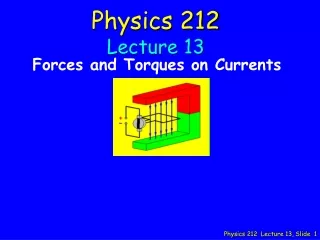
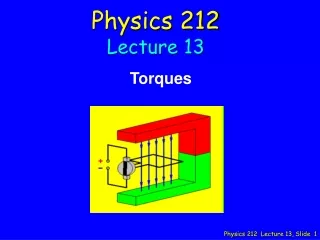
Physics 212 Lecture 13 Forces and Torques on Currents
Key Concepts: • Forces & Torques on loops of current due to a magnetic field. • The magnetic dipole moment. 05
Force on each charge Total force on wire Use Force on a wire carrying current I Cross sectional area A, Length L Number of charges/m3 = n Each charge moving at Vavg 06
Current- carrying wire in uniform B field Out of page
ACT A B C 08
ACT A B C 10
ACT • What is the force on section d-a of the loop? • Zero • Out of the page • Into the page 12
Checkpoint 1a A B C “The net force on any closed loop is zero.” 13
Checkpoint 1b y x • In which direction will the loop rotate? • (assume the z axis is out of the page) • Around the x axis • Around the y axis • Around the z axis • It will not rotate 15
Checkpoint 1c F R y A B C D E 17
Magnetic Dipole Moment Area vector Magnitude = Area Direction uses right hand rule Magnetic Dipole moment 19
z turnsmtoward B y m B z x m y B x turnsmtoward B The torque always wants to linemup with B ! 21
Practice with mand t I m z is up (turnsmtoward B) y m B x B In this casemis out of the page (using right hand rule) 22
Checkpoint 2a Biggest when Three different orientations of a magnetic dipole moment in a constant magnetic field are shown below. Which orientation results in the largest magnetic torque on the dipole? 24
Potential energy of a magnetic dipole moment Rotate from 1 to 2 27
U = 0 Lowest U parallel to B Highest U antiparallel to B U m B
Checkpoint 2b q f U = -mBcosq U = +mBcosf Three different orientations of a magnetic dipole moment in a constant magnetic field are shown below. Which orientation has the most potential energy? U = 0 30
ACT Three different orientations of a magnetic dipole moment in a constant magnetic field are shown below. We want to rotate the dipole in the CCW direction. qa fa qc B • First, consider rotating to position c. What are the signs of the work done by you and the work done by the field? • Wyou > 0, Wfield > 0 • Wyou > 0, Wfield < 0 • Wyou < 0, Wfield > 0 • Wyou < 0, Wfield < 0 • DU > 0, so Wfield < 0. Wyou must be opposite Wfield • Also, torque and displacement in opposite directions Wfield < 0 30
ACT Consider rotating the dipole to each of the three final orientations shown. qa fa qc B • Does the sign of the work done by you depend on which position (a, b, or c) the dipole is rotated to? • Yes • No The lowest potential energy state is with dipole parallel to B. The potential energy will be higher at any of a, b, or c. 30
Calculation z A square loop of side a lies in the x-zplane with current I as shown. The loop can rotate about x axis without friction. A uniform field B points along the +z axis. Assume a, I, and B are known. How much does the potential energy of the system change as the coil moves from its initial position to its final position. z . B B 30˚ y y a I x final initial • Conceptual Analysis • A current loop may experience a torque in a constant magnetic field • t = m X B • We can associate a potential energy with the orientation of loop • U= -m ∙ B • Strategic Analysis • Find m • Calculate the change in potential energy from initial to final 32
Calculation • What is the direction of the magnetic moment of this current loop in its initial position? (A) +x(B) -x(C) +y (D) -y . z z X m ● y x y Right Hand Rule z A square loop of side a lies in the x-zplane with current I as shown. The loop can rotate about x axis without friction. A uniform field B points along the +z axis. Assume a, I, and B are known. z . B B 30˚ y y a I x final initial 34
Calculation • What is the direction of the torque on the current loop in the initial position? (A) +x(B) -x(C) +y (D) -y . z X B m y z A square loop of side a lies in the x-zplane with current I as shown. The loop can rotate about x axis without friction. A uniform field B points along the +z axis. Assume a, I, and B are known. z . B B 30˚ y y a I x final initial 36
Calculation • What is the potential energy of the initial state? (A) Uinitial < 0 (B) Uinitial = 0 (C) Uinitial > 0 z B q m y z A square loop of side a lies in the x-zplane with current I as shown. The loop can rotate about x axis without friction. A uniform field B points along the +z axis. Assume a, I, and B are known. z . B B 30˚ y y a I x final initial 38
Calculation • What is the sign of the potential energy in the final state? (A) Ufinal < 0 (B) Ufinal = 0 (C) Ufinal > 0 z z initial final Energy must increase ! B B q = 90o + 30o q = 90o y y m m z A square loop of side a lies in the x-zplane with current I as shown. The loop can rotate about x axis without friction. A uniform field B points along the +z axis. Assume a, I, and B are known. z . B B 30˚ y y a I x final initial Check: m moves away from B 40
Calculation z B q = 120o y m z A square loop of side a lies in the x-zplane with current I as shown. The loop can rotate about x axis without friction. A uniform field B points along the +z axis. Assume a, I, and B are known. z . B B 30˚ y a I x final initial • What is the potential energy of the final state? (A) (B) (C) 44