Recent Advances from the STAR Experiment: Insights on Hadron Spectra and Azimuthal Correlations
510 likes | 649 Vues
This presentation highlights recent findings from the STAR experiment at RHIC, focusing on crucial measurements related to heavy ion physics and QCD. Key topics include the inclusive charged hadron spectra, azimuthal anisotropy, and two-particle correlations, providing insights into nuclear matter at high temperatures and densities. The findings address significant phenomena such as leading hadron suppression and elliptic flow, emphasizing their implications for understanding quark-gluon plasma and phase transitions. The STAR experiment's capabilities and results elucidate the behavior of strongly interacting matter under extreme conditions.


Recent Advances from the STAR Experiment: Insights on Hadron Spectra and Azimuthal Correlations
E N D
Presentation Transcript
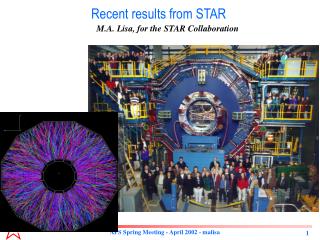
Recent advances from the STAR Experiment Highlights from Inclusive hadron spectra & Azimuthal correlations Manuel Calderón de la Barca
Outline • Heavy Ion Physics and QCD • STAR experiment at RHIC • Measurement highlights of interest to High Energy • Case I : Inclusive charged hadron spectra • Case II: Azimuthal anisotropy • Case III: Two-particle correlations • Conclusions
Heavy Ions: How does nuclear matter look at high temperature? High Density QCD Matter in Laboratory Determine its properties QCD Prediction: Phase Transitions Deconfinement to Q-G Plasma Chiral symmetry restoration Relevance to other research areas? Quark-hadron phase transition in early Universe Cores of dense stars High density QCD e ~ 1-3 GeV/fm3
BRAHMS PHOBOS RHIC PHENIX STAR Ions: A = 1 ~ 200, pp, pA, AA, AB The Relativistic Heavy Ion Collider Two Superconducting Rings Design PerformanceAu + Aup + p Max snn 200 GeV 500 GeV L [cm-2 s -1 ] 2 x 10261.4 x 1031 Interaction rates 1.4 x 10³ s -1 6 x 10⁵ s -1
Time Projection Chamber Magnet Silicon Strip Detector Silicon Vertex Tracker Forward Time Projection Chambers Photon Multiplicity Detector Vertex Position Detectors Endcap Calorimeter Barrel EM Calorimeter + TOF patch Detector components in STAR 1st year detectors (2000) 2nd year detectors3rd year detectors Coils TPC Endcap & MWPC Zero Degree Calorimeter Central Trigger Barrel RICH
Focus on high pt • We know very little about early time • Au+Au collisions to study strongly interacting matter under extreme conditions • Large momentum transfers early time scales • Use high pt jet phenomena as probe of medium • Hard scattering has been done… but not in hot medium • Measurement of fragmentation products insight into gluon density1 [1] R. Baier, D. Schiff, and B. G. Zakharov, Annu. Rev Part. Sci. 50, 37 (2000).
spectators Preliminary sNN = 200 GeV participants Uncorrected Centrality and Participants in HI Npart (Wounded Nucleons) ~ soft production Nbin ~ hard processes peripheral (grazing shot) Centrality classes based on mid-rapidity multiplicity central (head-on) collision
Case I : Leading hadron suppression Wang and Gyulassy: DE softening of fragmentation suppression of leading hadron yield Ivan Vitev, QM02
STAR High pT hadrons in Au+Au Preliminary (nucl-ex/0206011, PRL in press)
Preliminary Inclusive charged hadron suppression 130 and 200 GeV, Central/peripheral 130 GeV normalized to NN centrality dependence Clear evidence for high pT hadron suppression in central collisions significant nuclear interactions to very high pT Now seen by all 4 RHIC collaborations (BRAHMS, PHENIX, PHOBOS, STAR)
Asymmetry + interactions creates final state azimuthal correlations: elliptic flow lab-plane Geometry: asymmetric initial state STAR Preliminary 130GeV Case II: Azimuthal Anisotropy, or “Elliptic Flow” Fourier analysis 1+2v2cos2(lab-plane)
Asymmetry + interactions creates final state azimuthal correlations: elliptic flow lab-plane Geometry: asymmetric initial state STAR Preliminary 130GeV Case II: Azimuthal Anisotropy, or “Elliptic Flow” Finite v2 at high pt pT > 2GeV: v2 constant
Method I: Direct Jet Identification • jet-jet correlations in p+p? • jet-jet correlations in Au+Au? • Comparison statistical method
py trigger px associated 2 GeV 4 GeV Method II: High pT Correlations • Statistical leading particle analysis • Histogram in 2-d • N: vs. • project Ntrigger: Total number of trigger particles: (4<pT<6)
Mid-Central Au+Au Result: Au+Au Distribution • Harmonic structure • Peaks at 0, || • Non-zero mean value • How do we extract jet signal from background?
di-jets Flow Combinatorial background Resonance decays jets All Small Background Subtraction Subtract large correlations Isolate intra-jet correlations Removes di-jet signal
0-10% Most Central First Results: STAR 130 GeV Significant peak remains after subtraction Jets?!
Near angle persists after large subtractions Jets at 200 GeV
Near angle persists after large subtractions Jets at 200 GeV • Shape • Clear near & away side signal • Same sign correlation • Unlikely due to resonance decays
Near angle persists after large subtractions Jets at 200 GeV • Shape • Clear near & away side signal • Same sign correlation • Unlikely due to resonance decays di-jets in Au+Au?
Jet Charge Measured by DELPHI Well described by LUND string model Expect opposite charge sign between leading, next-to-leading charged particles
Charge Ordering • Fragmentation well described by string model • Gaussian fit to near-side: Jets at 200 GeV
Charge Ordering • Fragmentation well described by string model • Gaussian fit to near-side: Jets at 200 GeV
What Have we Shown? • First direct evidence of jets at RHIC • What about di-jets at RHIC? • Study away side in Au+Au • But… large subtraction removes away side • Need different method to deal with background
STAR Preliminary 130 GeV Reference Model • Au+Au correlations: • Jets • di-jets • elliptic flow • multiple hard-scatterings per event • Incorporate known sources of signal and dominant background
pp measurement Fit B in non-jet region Add p+p to background term Reference Model • Algorithm: Au+Au measurement Background term
Data Comparison to Ref. Model • Absolute scale • Background contribution increases with centrality • 4/7 centrality bins • Other bins qualitatively, quantitatively similar • Near side well matched for all centralities
Data Comparison to Ref. Model • Away-side suppression • Suppression increases with increasing centrality • Quantify with centrality:
Au+Au Measurement background p+p Measurement Quantify with Ratio
Dissappearance of the Jets from the Far Side Centrality dependent numerator Common denominator • Sys. errors: v2 +5/-20% Away-side suppression in central Au+Au • HIJING model: constant ratio=1
? Suppression of away-side jet consistent with strong absorption in bulk, emission dominantly from surface
s dependence (200/130) at high pT • Inclusive spectra: growth with s follows pQCD prediction (XN Wang) • (systematic uncertainties are correlated – better estimates in progress) • v2: independent of s for pT>2 GeV/c • Geometric origin of v2 at high pT? Rates change but shape does not.
Preliminary near side away side peripheral central Away side suppression: open issues • Why not 1 for peripheral? • evidently not due to experimental error or uncertainty • not due to mismeasured v2: even v2=0 has little effect for most peripheral and central • Initial state effects: • Shadowing in Au+Au? • Nuclear kT: Initial state multiple scattering Hijing estimate: Maximum 20% effect Resolution: Need to measure ind+Au
Summary of STAR high pT measurements • hadrons at pT>~3 GeV/c are jet fragments • central Au+Au: • strong suppression of inclusive yield at pT>5 GeV/c • suppression factor ~ constant for 5<pT<12 GeV/c • large elliptic flow, finite for non-central to pT~6 GeV/c • strong suppression of back-to-back hadron pairs • Possible interpretation: • Hard scattered partons (or their fragments) interact strongly with medium • Observed fragments are emitted from the surface of the hot & dense zone created in the collision ?
And back to our original question… • If partons absorbed: large DE large gluon • But have not yet proven partonicDE: where does absorption occur? • Is it an initial state, partonic effect, or late hadronic effect? • theory input: what are experimental handles to distinguish hadronic from partonic absorption? (e.g. correlation function widths) JETS JETS ?
Look forpartonic energy loss in dense matter Thick plasma (Baier et al.): Gluon bremsstrahlung Thin plasma (Gyulassy et al.): • Linear dependence on gluon density glue: • measure DE gluon density at early hot, dense phase • High gluon density requires deconfined matter (“indirect” QGP signature)
Future • Coming run: 50% of full barrel Electromagnetic Calorimeter • triggers: high tower, ET, jet • jets, p0, g, electrons • d+Au: • Cronin effect/nuclear <kT> • enhancement of inclusive yield • suppression of back-to-back pairs • gluon shadowing • Long term: • g-jet coincidences (“ultimate” jet energy loss experiment) • heavy quark jets (dead cone effect) • surprises….
Soft Physics • Chemical Freezeout ~ 170 MeV • Lattice 160 - 180 MeV • Collective motion • Large “Elliptic flow” • Large pressure gradients in the system • System seems to approach thermodynamic equilibrium • Kinetic freezeout ~ 110 MeV • Freezeout seems to be very fast, almost explosive
Energy loss in cold matter Wang and Wang, hep-ph/0202105 F. Arleo, hep-ph/0201066 Modification of fragmentation fn in e-A: dE/dx ~ 0.5 GeV/fm for 10 GeV quark x1 Drell-Yan production in p-A: dE/dx <0.2 GeV/fm for 50 GeV quark
Inclusive hadron suppression at RHIC Phenix p0: peripheral and central over measured p+p STAR charged hadrons: central/peripheral
v2: comparison to parton cascade Parton cascade (D. Molnar) • Detailed agreement if: • 5x minijet multiplicity from HIJING or • 13x pQCD gggg cross section extreme initial densities or very large cross sections
Preliminary v2: centrality and pT dependence • broad plateau, v2 finite at pT~10 GeV/c except for most central collisions • significant in-medium interactions to very high pT Shuryak (nucl-th/0112042): plateau exhausts initial spatial anisotropy
Near-angle correlations at high pT • Jet core:Df x Dh ~ 0.5 x 0.5 • look at near-side correlations (Df~0) of high pT hadronpairs • Complication: elliptic flow • high pT hadrons that are correlated with reaction plane orientation are also correlated with each other (~v22) • but elliptic flow has long range correlation (Dh > 0.5) • Solution: compare azimuthal correlation functions for Dh<0.5 and Dh>0.5
Preliminary Non-flow effects? • Non-flow: few particle correlations not related to reaction plane • jets, resonances, momentum conservation,… • contrast v2 from reaction plane and higher-order cumulants (Borghini et al.) • Non-flow effects are significant • 4th order cumulants consistent with other non-flow estimates • But large finite v2 and saturation persist at high pT
beam Single Particle Selection
Preliminary near side away side peripheral central Away side suppression and nuclear kT • same thresholds for AuAu and pp • nuclear <kT>: • enhances near-side in Au+Au • suppress away-side in Au+Au • similar centrality dependence Stronger near-side correlation for pTtrig>3 GeV/c than pTtrig>4 GeV/c
Central Au+Au: 6<pT(trigger)<8 GeV/c Stronger signal but limited statistics in non-central bins