Section 9.2 Pyramids, Area, & Volume
70 likes | 113 Vues
Learn about pyramids, their properties, and how to calculate their lateral surface area, total surface area, and volume. Explore the Pythagorean Theorem as it applies to pyramids.


Section 9.2 Pyramids, Area, & Volume
E N D
Presentation Transcript
Section 9.2Pyramids, Area, & Volume Section 9.2 Nack/Jones
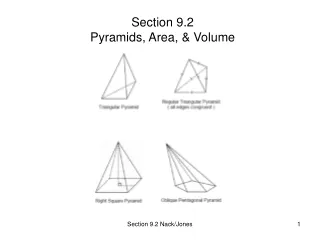
Pyramid • The solid figure formed by connecting a polygon with a point not in the plane of the polygon is called a pyramid. • The polygonal region is called the base & the point is the vertex. • A regular pyramid is a pyramid whose base is a regular polygon and whose lateral edges are all congruent. • The slant height of a regular pyramid is the altitude from the vertex of the pyramid to the base of any of the congruent lateral faces of the regular pyramid. • The line segment from the vertex perpendicular to the plane of the base is the altitude. Ex. 1 p. 415 Section 9.2 Nack/Jones
Pyramid • In the regular pyramid, the distance l is called the slant height of the lateral surfaces of a regular pyramid. • Theorem 9.2.1: In a regular pyramid, the length a of the apothem of the base, the altitude h, and the slant height l satisfy the Pythagorean Theorem, that is l² = a² + h² in every regular pyramid. l h a Section 9.2 Nack/Jones
LateralSurface Area of a Pyramid • Theorem 9.2.2: The Lateral Area L of a regular pyramid with slant height l and perimeter P of the base is given by: L = ½ pl It is simpler to find the area of one lateral face and multiply by the number of faces. Example 2 p. 415 Section 9.2 Nack/Jones
Total Surface Area • Theorem 9.2.3: The total area (surface area) T of a pyramid with lateral area L and base area B is given by ( the sum of the area of all its faces): T = L + B or T = ½ pl + B Example: To find the total area, Find the slant height. Apply Pythagorean Theorem to one face: l ² + 2² = 6² or l = 42 Find Lateral Area: L = ½ pl= ½42 (16) = 32 2 Find the area of the Base: 6 B = 16 l Total Area = 16 + 32 22 6 4 Section 9.2 Nack/Jones
Volume of a pyramid • Theorem 9.2.4: The volume V of a pyramid having a base area B and an altitude of length h is given by: V =1/3 Bh Example 6 p. 419:h = 12, side = 4 Find the area of the base: B = ½aP. Since it is a 30-60-90 triangle, we know that a = 23 B = ½ 23 (64) = 24 3 V =1/3 Bh = 96 3 units3 Section 9.2 Nack/Jones
Another application of the Pythagorean Theorem • Theorem 9.2.5: In a regular pyramid, the lengths of altitude h, radius r of the base and lateral edge e satisfy the Pythagorean Theorem, that is: e² = h² + r² Example 5 p. 418 Section 9.2 Nack/Jones