
Density and Volume: Understanding Matter's Properties
E N D
Presentation Transcript
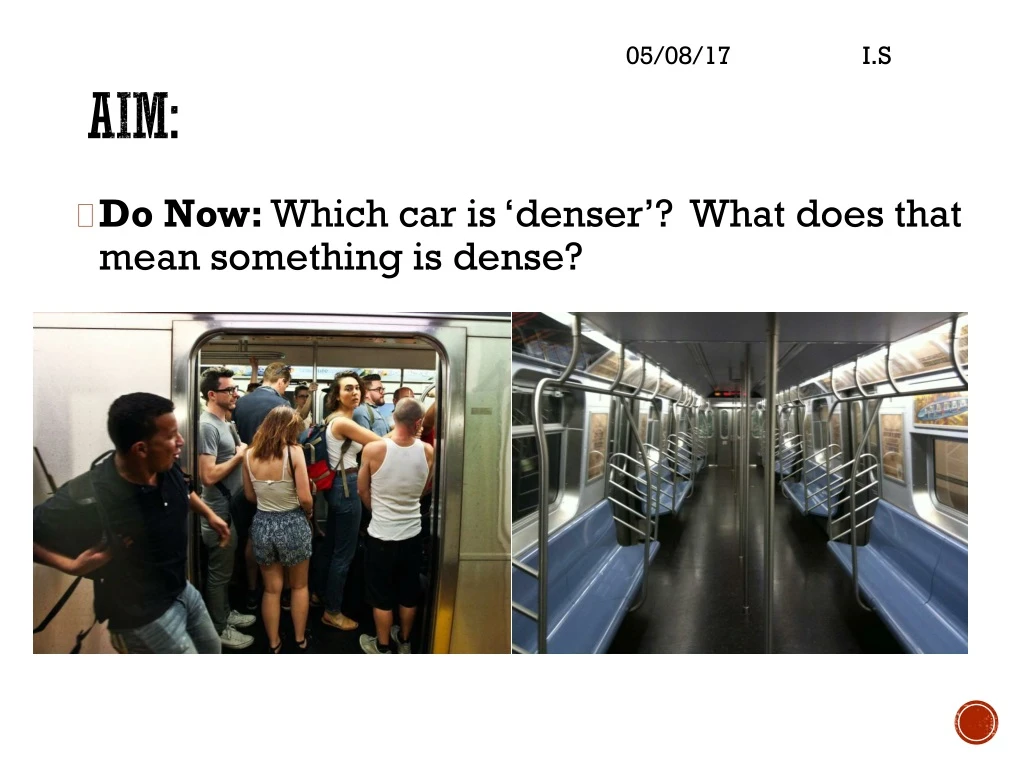
05/08/17 I.S AIM: • Do Now: Which car is ‘denser’? What does that mean something is dense?
Do now: Turn & Talk to your partner. Compare 1kg of feathers and 1 kg of steels. 1. Which do you think would take up more space? Why? 2. Which do you think would have the greater Mass? Why? 1 kg of steels 1 kg of feathers
Which do you think would have the greater volume? The greater mass?Why? 1 kg of steels 1 kg of feathers
What is Mass? -The amount of matter in an object. -Unit of measurement = g (gram) -What tool do we use to find mass? Triple Beam Balance
There are 3 states of matter: Solid Liquid Gas
What is Volume? - Measurement of the amount of space an object takes up -Unit of measurement = ml (milliliter) or cm3 (cubic centimeter) -What tools can we use to find volume?
Finding Volume of Cube -Volume of a cube = Length x Width x Height = L x W x h -Let’s practice! Cube: 2 cm L, 2 cm W, 2 cm h Did you say 8 cm3?
1kg of steel VS 1kg of feathers • https://www.youtube.com/watch?v=yuOzZ7dnPNU
Density It is a measure of how tightly packed and how heavy the molecules are in an object. Density is the amount of matter within a certain volume.
Which one is more dense? Demonstration: People in a square How about this: Which square is more dense?
Which one is more dense? Now which one is more dense?
05/08/17 I.S AIM: • Do Now: Which car is ‘denser’? What does that mean something is dense?
To find the density 1- Find the mass of the object 1- Find the mass of the object 3- Divide Density = Mass g Volume c³ 2- Find the volume of the object ALWAYS REMEMBER UNITS!
To find density: • Find the mass of the object • Find the volume of the object • Divide : Density = Mass ÷ Volume Ex. If the mass of an object is 35 grams and it takes up 7 cm3 of space, calculate the density.
To find density: • Find the mass of the object • Find the volume of the object • Divide : Density = Mass ÷ Volume Ex. If the mass of an object is 35 grams and it takes up 7 cm3 of space, calculate the density Set up your density problems like this: Given: Mass = 35 grams Unknown: Density (g/ cm3) Volume = 7 cm3 Formula: D = M / V Solution: D = 35g/7 cm3 D = 5 g/cm3
Let’s try some density problems together Work on these problems with your neighbor 1 Frank has a paper clip. It has a mass of 9g and a volume of 3cm3. What is its density?
2. Frank also has an eraser. It has a mass of 3g, and a volume of 1cm3. What is its density?
3. Jack has a rock. The rock has a mass of 6g and a volume of 3mL. What is the density of the rock?
4. Jill has a gel pen. The gel pen has a mass of 8g and a volume of 2ml. What is the density of the rock?
Finding Volume of an Irregular Shaped Object -Can’t use a ruler!!! -Find volume by water displacement method. -Volume of water with object – volume of water before object -Don’t forget to read the graduated cylinder from the bottom of the meniscus!!!
How about this one? Be careful!!! 4.3 ml
Last one! 23 ml
Measuring Volume by Displacement Steps: Reading the initial water volume Submerge object into the water Read the final water volume Final vol – Initial vol Used for irregular shaped objects
Do the math 1 . Original reading of volume • Final volume of water • This will equal the volume of the object • 22.5 mL - 17.4 mL = 5.1 mL • Therefore, the volume of the object by displacement is 5.1 mL
Using Water Displacement to Calculate Volume • Measure the level of the water in a container. 70 ml 60 ml 50 ml 40 ml 30 ml 20 ml 10 ml
Using Water Displacement to Calculate Volume • Measure the level of the water in a container. 30 ml 70 ml 60 ml 50 ml 40 ml 30 ml 20 ml 10 ml
Using Water Displacement to Calculate Volume • Measure the level of the water in a container. 30 ml • Insert an object in the water. We’ll use a metal ball. 70 ml 60 ml 50 ml 40 ml 30 ml 20 ml 10 ml
Using Water Displacement to Calculate Volume • Measure the level of the water in a container. 30 ml • Insert an object in the water. We’ll use a metal ball. 70 ml 60 ml 50 ml 40 ml 30 ml 20 ml 10 ml
Using Water Displacement to Calculate Volume • Measure the level of the water in a container. 30 ml • Insert an object in the water. We’ll use a metal ball. 70 ml 60 ml 50 ml 40 ml 30 ml 20 ml 10 ml
Using Water Displacement to Calculate Volume • Measure the level of the water in a container. 30 ml • Insert an object in the water. We’ll use a metal ball. 70 ml 60 ml 50 ml 40 ml 30 ml 20 ml 10 ml
Using Water Displacement to Calculate Volume • Measure the level of the water in a container. 30 ml • Insert an object in the water. We’ll use a metal ball. 70 ml 60 ml 50 ml 40 ml 30 ml 20 ml 10 ml
Using Water Displacement to Calculate Volume • Measure the level of the water in a container. 30 ml • Insert an object in the water. We’ll use a metal ball. 70 ml 60 ml 50 ml 40 ml 30 ml 20 ml 10 ml
Using Water Displacement to Calculate Volume • Measure the level of the water in a container. 30 ml • Insert an object in the water. We’ll use a metal ball. 70 ml 60 ml 50 ml 40 ml 30 ml 20 ml 10 ml
Using Water Displacement to Calculate Volume • Measure the level of the water in a container. 30 ml • Insert an object in the water. We’ll use a metal ball. 70 ml 60 ml 50 ml 40 ml 30 ml 20 ml 10 ml
Using Water Displacement to Calculate Volume • Measure the level of the water in a container. 30 ml • Insert an object in the water. We’ll use a metal ball. 70 ml 60 ml 50 ml 40 ml 30 ml 20 ml 10 ml
Using Water Displacement to Calculate Volume • Measure the level of the water in a container. 30 ml • Insert an object in the water. We’ll use a metal ball. 70 ml 60 ml 50 ml 40 ml 30 ml 20 ml 10 ml
Using Water Displacement to Calculate Volume • Measure the level of the water in a container. 30 ml • Insert an object in the water. We’ll use a metal ball. 70 ml 60 ml 50 ml 40 ml 30 ml 20 ml 10 ml
Using Water Displacement to Calculate Volume • Measure the level of the water in a container. 30 ml • Insert an object in the water. We’ll use a metal ball. 70 ml 60 ml 50 ml 40 ml 30 ml 20 ml 10 ml
Using Water Displacement to Calculate Volume • Measure the level of the water in a container. 30 ml • Insert an object in the water. We’ll use a metal ball. 70 ml 60 ml 50 ml 40 ml 30 ml 20 ml 10 ml
Using Water Displacement to Calculate Volume • Measure the level of the water in a container. 30 ml • Insert an object in the water. We’ll use a metal ball. 70 ml 60 ml 50 ml 40 ml 30 ml 20 ml 10 ml
Using Water Displacement to Calculate Volume • Measure the level of the water in a container. 30 ml • Insert an object in the water. We’ll use a metal ball. 70 ml 60 ml 50 ml 40 ml 30 ml 20 ml 10 ml
Using Water Displacement to Calculate Volume • Measure the level of the water in a container. 30 ml • Insert an object in the water. We’ll use a metal ball. 70 ml 60 ml 50 ml 40 ml 30 ml 20 ml 10 ml
Using Water Displacement to Calculate Volume • Measure the level of the water in a container. 30 ml • Insert an object in the water. We’ll use a metal ball. 70 ml 60 ml 50 ml 40 ml 30 ml 20 ml 10 ml