
Understanding Trigonometric Functions and Their Periodicity in Signal Analysis
This document explores the characteristics of various trigonometric functions including sine, cosine, and tangent within the context of periodic signals. It examines the reflections, amplitudes, and periods of these functions, highlighting their specific mathematical transformations. Additionally, concepts such as cotangent, cosecant, and secant functions are discussed in terms of their periodicity and real-world applications in signal processing. Understanding these principles is crucial for analyzing waveforms and oscillations in physics and engineering.

Understanding Trigonometric Functions and Their Periodicity in Signal Analysis
E N D
Presentation Transcript
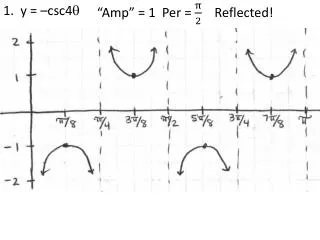
1. y = –csc4 “Amp” = 1 Per = Reflected!
2. y = 3cot – 4 “Amp” = 3 Per = VS 4 y = -4
3. y = ½ sec + 2 “Amp” = ½ Per = 2 VS 2 y = 2
4. y = –tan “Amp” = 1 Per = Reflected!
5. y = csc “Amp” = 1 Per = 2 P.S. =
6. y = 2cot( + 2) “Amp” = 2 Per = P.S. = -2
7. y = sec “Amp” = 1 Per = 4 P.S. =
8. y = tan + 4 “Amp” = Per = 3 V.S. 4 y = 4