Understanding Systems Intelligence: The Interplay of Human and Environmental Feedback
Systems Intelligence (SI) combines human sensitivities with analytical thinking to foster productive actions within complex systems. It emphasizes holistic engagement with feedback mechanisms of the environment, where each individual perceives themselves as part of a larger whole. This concept extends beyond traditional forms of intelligence, linking to Systems Thinking, philosophical practices, and decision-making theories. SI not only enhances personal mastery but also allows for the evolution of systems through human influence, making it an invaluable competency for navigating adaptive challenges in a dynamically interconnected world.

Understanding Systems Intelligence: The Interplay of Human and Environmental Feedback
E N D
Presentation Transcript
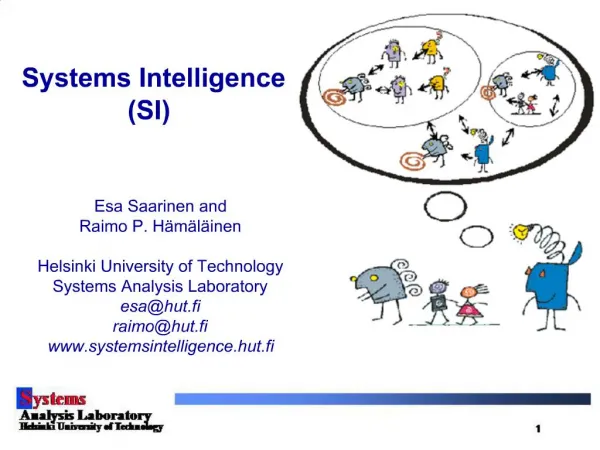
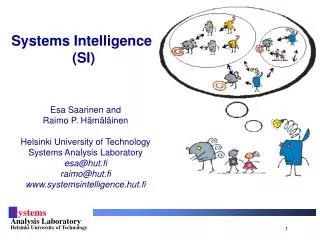
Systems Intelligence (SI) Esa Saarinen and Raimo P. Hämäläinen Helsinki University of Technology Systems Analysis Laboratory esa@hut.fi raimo@hut.fi www.systemsintelligence.hut.fi
Systems Intelligence • Intelligent behaviour in the context of complex systems involving interaction and feedback • A subject acting with Systems Intelligence engages successfully and productively with the holistic feedback mechanisms of her environment • She perceives herself as part of a whole, the influence of the whole upon herself as well as her own influence upon the whole • By observing her own interdependence in the feedback intensive environment, she is able to act intelligently
Systems Intelligence • Combines human sensitivities with engineering thinking with the idea of making things work • Systems Intelligence is a mirror that helps to identify productive forms of action one already follows intuitively • Our conviction is that Systems Intelligence is a key form of human intelligence • A fundamental element in the adaptive human toolbox • It is a competence that can be improved by learning
Multiple Intelligences (Howard Gardner 1983) • Linguistic Intelligence • Musical Intelligence • Logical-Mathematical Intelligence • Spatial Intelligence • Bodily-Kinesthetic Intelligence • The Personal Intelligences – intra / inter • Gardner:These do not yet explain higher-level cognitive capacities e.g. common sense, metaphorical capacity or wisdom
SI and Multiple Intelligences • SI points beyond the forms of intelligence of Gardner (Multiple Intelligences) and Goleman (Emotional Intelligence) in linking intelligence with the concept of system • Systems Intelligence is another important higher level human cognitive capacity • Inspiration from the work of Peter Senge (1990) • Systems Intelligence is a survival asset we have as a species
Systems Intelligence links: • Systems Thinking (Churchman 1968, Senge 1990, Checkland 1999, Flood 1999) • Philosophical Practice and Dialogue (Bohm 1980, Isaacs 1999) • Socratic tradition in philosophy which emphasises conceptual thinking for the purposes of the good life (Hadot 1987, Long 2002) • Therapeutic thinking, positive psychology and situation analysis (Bateson 2000, Goffman 1974, Seligman 2002) • Theories of Decision Making and Problem Solving (Simon 1956, Keeney 1992, Kahneman, Tversky 2000)
The Fifth Discipline (Senge 1990) • Cornerstones of learning organizations: • Personal Mastery • Mental Models • Shared Vision • Team Learning • Systems Thinking • Systems Intelligence is the fundamental link between • Personal Mastery and Systems Thinking.
Systems Thinking • Observes interdependencies and wholes • Views matters from different perspectives • Especially through the eyes of others • Becomes Systems Intelligencewhen a person takes active personal responsibility for her actions within the system
Systems Thinking is only the first step • Emphasizes the importance of wholes and perspectives as it conceptualises and models systems of interaction and feedback from outside • Can become a trap when one only sees systems from outside and does not recognize herself being an active part of them
Systems IntelligenceBasic ideas – wholes and parts • Whole is more important than parts • “Part” and “Whole” are relative abstraction • Always subject to potential redefinition by changing the perspective • Human agents can influence entire systems • Systems evolve over time producing complex often non obvious responses
Systems IntelligenceBasic ideas - systems approach • Human beings perceive themselves as independent individuals - yet most often they are encompassed in systems • Systems approach starts when you want to perceive the world through the eyes of another person • Systems approach looks beyond isolated linear cause-and-effect chains for interconnections and interrelations
Systems IntelligenceBasic ideas - structures • Structure produces behaviour • Beliefs regarding structures produce behaviour • Beliefs regarding the beliefs others have regarding structures, produce behaviour • Structures of co-operation are fundamentally based on the assumptions and meta-assumptions people make of others involved in that system of co-operation
Characteristics of systems • A system is characterized by the interconnections of its elements, as well as the internal nature of those elements (physical, emotional, social…) • A system has generative power. It produces effects beyond the modes and functionalities of its elements • A system has primacy over its elements while at the same time the elements influence the system • Dynamics is essential. It is generated and related to delays, accumulation, inertia etc. both in the human and organizational elements
Examples of human systems • Administration • Society • Organization • Company • Industry • Traffic • Internet • Group • Lecture • Meeting • Family • Friendships • School • Village
Systems can take over • People can get caught in systems that serve nobody’s interest • There does not need to be an external reason for the particulars of a system, yet people in the system can feel helpless regarding their possibilities of changing the system • In most systems, each subject separately reacts to the system without seeing the cumulative overall effect of the reactive behaviours on the others
Moral of Systems Intelligence • Systems Intelligence is about the betterment and improvement of human life • Takes the ancient promise of Good Life philosophy seriously • In systems thinking tradition, the work of C. West Churchman had a strong moral motivation • This has not received due credit (see e.g. Churchman 1982).
From Systems Thinking ... • The environment and one’s place in it are perceived in terms of interconnectivity and interdependence • The systems perspective wants to see the world as composed of systems, to examine these entities as wholes • Yet wholes are abstractions • They are mental constructs, which are relative to the perspective adopted • Boundaries of a system can always be redrawn
... to Systems Intelligence • Like Systems Thinking, Systems Intelligence wants to see wholes and account for change • Unlike Systems Thinking, Systems Intelligence involves driving change and actively embracing change • Unlike Systems Thinking, Systems Intelligence is primarily outcome-oriented and not a descriptive effort • It is intelligence-in-action on its way to create successful systemic change
Systems Intelligence is • Philosophy of life • Situational awareness • Common sense • Basic form of intelligent behaviour • A way out of egocentricity • Aiming at achievements reachable by common effort
Systems Intelligence • Becomes a challenge for personal learning • Involves instinctual, intuitive, tacit, subconscious and unconscious and inarticulate aspects that cannot be straightforwardly reduced to a full-fledged and transparent cognitive dimension • The theoretical understanding of Systems Thinking need not increase Systems Intelligence
Four dimensions of change • Mental change • Perceptual change • Individual behavioural change • Change in the system
Mental models • Systems Intelligence begins when the person starts to re-think her thinking regarding her environment and the feedback structures and other systems structures of that environment • Identifying one’s favoured framing patters, challenging them and adjusting them accordingly • A Systems Intelligent person will acknowledge the limitations of her thinking and mental models particularly through challenging her own thinking
Thinking about thinking • Key to learning Systems Intelligence • Acknowledging that one’s action and behaviours are a function of one’s thinking (mental models, beliefs, assumptions, interpretations, etc.) • In order to act more intelligently in the holistic systemic environment, I need to mirror mental models and engage in meta-level thinking regarding my own thinking • Re-framing is a key to new opportunities, higher productivity and to creativity
Seeing oneself in the system • The impact of one’s behaviours and interaction patterns upon the behaviours of others • The impact of other agents’ feedback on my behaviour • The impact of the current system on all of us is in the long run • The impact of everyone’s behaviours, in the long run • The modes of conformity I have already adopted as a result of established practices • The modes of conformity the others have already adopted as a result of established practices • The desired ideal state I would like to reach with the others
A Systems Intelligent Person • Avoids ”shifting the burden” –behaviour (see Senge 1990) i.e. avoids reactive behaviour and focusing on the removal of symptoms • In problem situations and their solutions – do I try to remedy the cause or the consequence – what is the outcome? • Dealing with the consequences often systemically escalates the problem via systemic secondary effects
Systems Intelligence in Everyday Life • Appreciation • No judgements • Interest • Humor • Listening • Thanking • Encouragement • Friendliness
Systems Intelligence in human interaction • “Inquiry-mode” in the sense of Senge, as opposed to “advocate mode”. • Dialogue techniques. • Listening to – techniques. • Facial expressions and bodily gestures that express openness and human acceptance, rather than prompt out fear. • Meta-level techniques that reinforce the subject’s awareness of the interpretative nature of her images and internal representations of the people around
Visible System • We often perceive systems only through a mechanistic perspective • Organizations are developed by focusing on the visible part and variables e.g. by savings and improving productivity • Often human resources are also perceived only through these visible systems
Invisible System • There is always a human system along the technical / economic organizational system • Is generated by the human system of emotions • Subjective variables are crucial • The emotional system cannot be reduced to objective mechanistic variables • Controls the fate of the organization as much or more than the visible system
SI Connects Engineering Thinking and Emotions • A systems engineering perspective to the systemic impacts of feelings • Human emotions are essential – they cannot be ignored – their systemic effects need to be taken into account intelligently • From reactive behaviour into the intelligent management of situations, feelings and the whole
Change with System Intelligence • Does the structure perceived allow a possibility for change? Is there a hidden subsystem? • Changing the mental mode = innovation • Inquiry mode • Indirect influence – what would be your solution?
Managing the invisible • In most human systems and organizations the true system often includes hidden subsystems such as processes of fear or trust generation • It is very easy to forget to use behavioural input variables controlling the invisible part • To understand the system, it can be more important to know what is not produced than what the standard output is • A Systems Intelligent approach acknowledges and aims to identify and understand both the visible and invisible part of the system and find inputs to impact their behaviour in a positive way
Changing the system • People adjust to systems instinctively. If a system is changed, people also change their behaviours. This leads to further change • Interventions: • intervention by changing one’s own behaviour: intentional new input, behaviour or structural change by a person in the system • disturbance from outside: organizational change, external catastrophe; major change in the environment
Optimism for change • Systems Intelligence focuses on changes as leveraged by the human mental world and the systemic nature of life around us • Systems Intelligence acknowledges that beliefs influence actions and actions influence beliefs. • There might be a systematic flaw in the way a group of agents perceives the way others think and what they truly want • A relatively small change in my behaviour might trigger a chain of changes in the actual behaviours in each of us
Minimal input - maximal output • Possibility of systemic change on the basis of an input, sometimes minimal input • Belief systems and meaning systems of the people are important • A minimal change might symbolize something essential triggering an effect of potentially enormous proportions
Possibilities for co-operation • People are more sensitive to ill-treatment imposed from outside upon oneself than to the ill-treatment oneself generates upon others • As a result, most human systems generate ill-treatment upon its members, even when no intention to that effect exists • All human systems have a tendency to slide towards the negative, unless a conscious and creative effort is launched
Collapse of Systems Intelligence • Reactionary Midset - creates the System of Holding Back in Return • Fear - feeds systems dictatorship and subservience to the status quo • Static State Thinking - the world is not static. • Command and Control Thinking - sees no need to seek out fresh perspectives • Elementalism and Individualism - leaves out human processes • Cynicism - assumes there is an upper limit to everything
Systems Theory and Systems Intelligence • A system is defined by identifying the system inputs i.e. control, intervention, decision or stimulus variables and system output variables i.e. the observed responses or reactions • The state of a system consists of the variables representing the elements in the system which determine its future behaviour • Systems can have many different state representations
Complexity • Well known parts – unknown interactions output/ observation control/ intervention • The interdependence of subsystems is unknown • A minor intervention can trigger unexpected, chaotic or bifurcating responses in the system • The most essential part of the system may be one that nobody has ever built into it
Controllability • The controllability of subsystems control/ intervention output/ observation • A system is controllable if it can be driven to any state value by sufficiently rich controls • In addition to the controllable system there can be an uncontrollable subsystem – human or technical – creating system dictatorship
System state and feedback • Negative feedback acts to decrease, i.e. stabilize, deviations from the goal • Positive feedback reinforces deviations • Systems can have triggering states or controls which lead to a completely new overall behaviour. Such phenomena are called chaotic • A system is controllable if we can bring it with the available control variables from one state to any other state in a finite time
Uncontrollability – System Dictatorship • The structure and limited input variables can create a situation of uncontrollability – system dictatorship • Even if a system mainly consists of human agents the overall behaviour can be determined by the non-human elements and dynamic structures such as time delays and sequential communication patters (e.g. Beer Game, Senge 1990) • Systems Intelligence is aware of structures: even if all the agents try to do their best the resulting system response can be bad due to the structure
SI in Emotional Systems control/ intervention output/ observation Systems Intelligent intervention • SI looks for ways to address the invisible subsystem of emotional interactions • Without the management of the whole the structure starts to produce uncontrollable behaviour – we have systems dictatorship
Systems Intelligent Leader • Is aware of the human perspective • Operates within the visible system and directs the emotional system simultaneously • Is not held captive by the mechanistic perspective • Breaks structural systems dictatorships
Systems Intelligent Organization • In a systems intelligent organization people take into account the effects of their actions on the others • The fear parameter is consciously kept to a minimum • People are responsive to flourishing initiatives • People are realistic and trust in the good will of others • The relaxed atmosphere is extended everywhere • The processing capacity is not restricted to the measurable variables recognized by the mechanism but is extended to the world of emotions and beliefs • Innovativeness is elevated when emotional variables do not limit it
Systems Intelligence as a Form of Ecological Rationality In experimental games : People choose co-operative strategies with Systems Intelligence. They do not take everything for themselves.
Ecological Systems Intelligence • Human decision making does not follow the axioms of rationality assumed in economic theory. • Bounded rationality: choice behaviour strongly reflects the decision environment and the process i.e. it is adaptive • Prisoner’s Dilemma: an escape from local status quo is not possible by self-interested rationality • Evolutionary processes exhibit the spontaneous emergence of co-operation generating superior dominating overall behaviour for all the actors (Axelrod 1984, Gintis et al. 2003) • Can be interpreted as a manifestation of ecological Systems Intelligence
Thanks to evolution we all have Systems Intelligence!Thank you.
Esa Saarinen ja Raimo P. Hämäläinen:Systems Intelligence : Connecting Engineering Thinking with Human Sensitivityin:Systems Intelligence – Discovering a Hidden Competence in Human Action and Organizational Life, Raimo P. Hämäläinen and Esa Saarinen Editors, Helsinki University of Technology, Systems Analysis Laboratory Research Reports A88, October 2004Downloadable at: www.systemsintelligence.hut.fi Basic Reference
Internet sites • Systems Intelligence Research Group, • http://www.systemsintelligence.hut.fi/ • Downloadable articles on SI: • http://www.systemsintelligence.tkk.fi/SI2004.html • Saarinen Esa, • http://www.esasaarinen.com • http://www.sal.hut.fi/Personnel/Homepages/EsaS.html • http://www.sal.hut.fi/Personnel/Homepages/EsaS.html • http://www.esasaarinen.com/luennot/?sivu=yritysluennot&kieli=en • Hämäläinen Raimo P., • www.raimo.hut.fi