Understanding Data Structures: Organizing Information for Efficient Computing
100 likes | 270 Vues
This overview highlights the significance of data structures in programming, emphasizing their role in optimizing resource constraints, enhancing program efficiency, and effectively managing complex computations. By selecting the appropriate data structure based on operational needs and resource availability, programmers can significantly reduce execution time and computational costs. The course aims to familiarize learners with common data structures, measure their effectiveness, and understand the balance of costs and benefits inherent in each structure. Through practical examples, such as bank account transactions, we explore the concepts of abstract data types and the difference between logical and physical data forms.


Understanding Data Structures: Organizing Information for Efficient Computing
E N D
Presentation Transcript
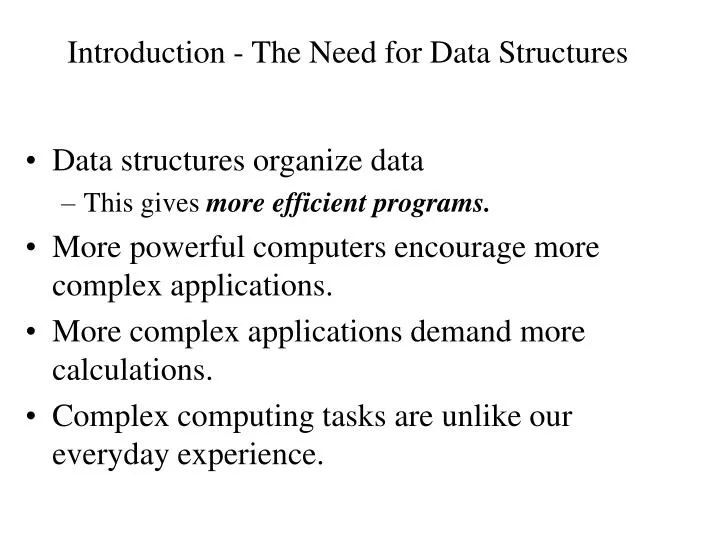
Introduction - The Need for Data Structures • Data structures organize data • This gives more efficient programs. • More powerful computers encourage more complex applications. • More complex applications demand more calculations. • Complex computing tasks are unlike our everyday experience.
Organization • Any organization for a collection of records can be searched, processed in any order, or modified. • The choice of data structure and algorithm can make the difference between a program running in a few seconds or many days. • A solution is said to be efficient if it solves the problem within its resource constraints. • Space • Time • The cost of a solution is the amount of resources that the solution consumes.
Selecting A Data Structure • Select a data structure as follows • Analyze the problem to determine the resource constraints a solution must meet. • Determine basic operations that must be supported. Quantify resource constraints for each operation. • Select the data structure that best meets these requirements. • Some questions to ask: • Are all the data inserted into the structure at the beginning or are insertions interspersed with other operations? • Can data be deleted? • Are the data processed in some well-defined order, or is random access allowed?
Data Structure Philosophy • Each data structure has costs and benefits. • Rarely is one data structure better than another in all situations. • A data structure requires: • space for each data item it stores, • time to perform each basic operation, • programming effort. • Each problem has constraints on available time and space. • Only after a careful analysis of problem characteristics can we know the best data structure for the task.
Example • Bank account transactions • Open an account: a few minutes • Withdraw from the account: a few seconds • Add to the account: overnight (or more) • Close the account : overnight
Goals of this Course • Reinforce the concept that there are costs and benefits for every data structure. • Learn the commonly used data structures. • These form a programmer’s basic data structure “toolkit”. • Understand how to measure the effectiveness of a data structure or program. • These techniques also allow you to judge the merits of new data structures that you or others might invent.
Definitions • A type is a set of values. • E.g., boolean, int • Can be an infinite set (but not on a computer) • A data type is a type and a collection of operations that manipulate the type. • E.g., && || + - * >> << • A data element or element is a piece of information of a record. • A data item is said to be a member of a data type. • A simple data item contains no subparts. • An aggregate data item may contain several pieces of information.
Abstract Data Types • Abstract Data Type (ADT): a definition for a data type solely in terms of a set of values and a set of operations on that data type. • Each ADT operation is defined by its inputs and outputs. • The process of hiding implementation details is known as encapsulation. • C++ implements this concept with the class declaration (.h file or prototypes).
Data Structure • A data structure is the physical implementation of an ADT. • Each operation associated with the ADT is implemented by one or more subroutines (functions) in the implementation. • Data structure usually refers to an organization for data in a computer’s main memory. • File structure is an organization for data on peripheral storage, such as disk or tape. • C++ implements this concept with the class implementation (public and private functions and data).
Logical vs. Physical Form • Data items have both a logical and a physical form. • Logical form: definition of the data item within an ADT. • Physical form: implementation of the data item within a data structure. • For example, the concept (logical form) of a list could be implemented (physical form) using an array or a linked list.