Understanding Simple Machines: How They Make Work Easier
This guide explores the fundamental concepts of simple machines that facilitate work by transferring energy. It outlines the six major simple machines: levers, pulleys, wheel and axles, inclined planes, wedges, and screws. Each type is described with practical examples, explaining how they function to change the direction or magnitude of force applied. Additionally, key concepts such as mechanical advantage, ideal mechanical advantage, and efficiency are discussed, highlighting the crucial relationship between input and output work in machines.

Understanding Simple Machines: How They Make Work Easier
E N D
Presentation Transcript
Machine notes CP Physics Ms. Morrison
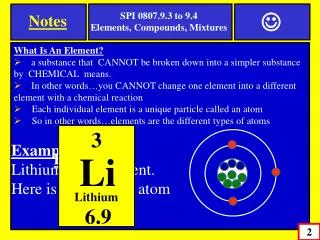
Machines • Devices that make work easier to do (transfer energy) • Two ways make work easier: • Machines change the direction of your force. (ex. Pulleys) • Machines multiply the force you apply to it. • Note: You do the work on the machine and then the machine does work on the object.
Simple Machines • Six Simple Machines • Levers • Pulleys • Wheel and axles • Inclined Planes • Wedges • Screws
Levers • Long rigid bar with a support called a fulcrum • Examples: crowbars, car jacks
Pulleys • Special type of lever • Has grooved wheel over which a rope passes • Can have a single pulley or combinations of pulleys • Examples: window shade pulls, block and tackle, well, flag poles
Wheel and axle • Special type of lever • Consists of a wheel attached to an axle • Examples: pencil sharpener, egg beater
Inclined plane • Flat surface with one end higher than the other • Examples: moving ramps, wheelchair ramps
Wedge • Inclined plane with either one or two sloping sides • Examples: door stops, knives, axes, scissors, chisels
Screw • An inclined plane which is spiral, you move the plane rather than the load • Examples: wood screws
Mechanical advantage • Indicates how much the machine multiplies your force • Equation: MA = Fr/Fe • MA = mechanical advantage (no unit) • Fr = resistance force (equals weight of the object) • Fe = effort force (force you apply to the machine)
Ideal mechanical advantage • Second form of mechanical advantage • Based on an ideal machine which transfers 100% of your energy • Equation: IMA = de/dr • IMA = ideal mechanical advantage • de = effort distance (distance you apply force) • dr= resistance distance (distance machines moves)
Efficiency • Shows how much of the work you put into the machine (input work) is actually used to do work on the object by the machine (output work) • Equation: Efficiency = Wo/Wi x 100% • Wo = output work (J) • Wi = input work (J) • Machines cannot multiply your work or energy – they can only multiply force • MACHINES CANNOT DO MORE WORK THAN THE WORK YOU PUT INTO THEM