Download
1 / 23
230 likes | 358 Vues
This article delves into the fundamental principles of force and motion as described by Newton's laws. It explores the concept of inertia (Newton's First Law), explains how unbalanced forces cause acceleration (Newton's Second Law), and discusses action-reaction pairs (Newton's Third Law). The law of universal gravitation, weight, and mass are also outlined, along with real-world examples and calculation problems to enhance understanding. This comprehensive guide serves as an essential resource for students and enthusiasts of physics.

E N D
Force and Newton Laws Aqeel Mohamed &Christian Martinez
Dynamics • Observation of objects in nature • If a body is not under the influence of force, it is at rest or a natural state. - Aristotle • Claim is refuted by Newtonian Law
Motion • Change in the location of an object over a period of time. • Speed and direction is maintained of an object is in motion. • Newton’s Three Laws help in our understanding of the properties of motion.
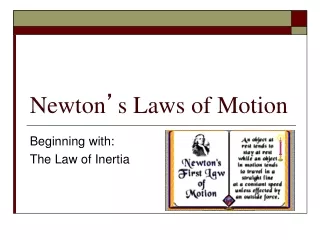
Newton’s First Law: Inertia • Matter would resist a change in motion. • If a force acts upon an object, it would continue to move indefinitely in the direction the force acted in. • The larger a mass, the more inertia (resistance to change in motion) an object would have.
Newton’s Second Law:Acceleration • An unbalanced force acting on an object causes the object to accelerate in the direction of the force. • Acceleration is the change in magnitude of velocity or direction. • Situation occurs when resultant force or the net force is NOT zero.
Formula • Acceleration is directly proportional to the net force. • Acceleration is indirectly proportional to an object’s mass • a= F/m • Where “a” is acceleration, “F” the net force, and “m” the mass of the object
Force • Expressed in Newtons (N) • 1(N)= 1kg x m/s^2 • Net force can be represented as the product of an object’s mass and accelaration • F=ma
Third Law of Motion • For every reaction, there is an equal and opposite reaction. • Forces always occur in pairs when acting on an object. Second object of two objects will exert a force equal to the force the first object originally exerted. • Never act on the same object or could be combined. (same magnitude but opposite in direction)
Law of Universal Gravitation • All objects have the ability to attract other objects. • Gravitational pull is proportional to mass. The greater the mass, the greater the gravitational pull.
Weight • The “pull” felt by objects on Earth • Product of acceleration due to gravity and an object’s mass. • Weight is a “force due to gravity” • F= ma g=a • F=mg • g= 9.81 m/s^2 (acceleration due to gravity
Gravitational Force of Two Objects • Gravitational force between two objects is inversely proportional to the square of their distance and directly proportional to their masses • F=(Gm1m2)/r^2 • (G= 6.67 x 10 ^-11 N x m^2/kg^2) • G represents the Universal Gravitational Constant
Inverse Square Relationship • Distance between masses increases, gravitational force between objects decrease. • Example: (if the distance of two masses is doubled, the force is reduced to one forth the original value) • 2^2 = 4 then Find reciprocal value = ¼
Question 1 • A 120-N net force acts upon a 68-kg cart at rest. What acceleration results?
Solution 1 • a=F/m • a= 120N/68kg • a=(120 kg x m/s^2)/ (68kg) • a=1.8 m/s^2
Question 2 • A force of F Newtons causes a mass of m kilo-grams to accelerate at 24 m/s^2. What acceleration would occur in the following conditions? • -the force is doubled to 2F Newtons and mass remains the same • -The force F Newtons is constant and the mass is tripled.
Solution 2 • Acceleration is directly proportional to an object’s net force, therefore: • a=2(24 m/s^2)= 48 m/s^2 • Acceleration is inversley proportional to mass, when mass is tripled, there is a decrease in acceleration, thefore: • a= (24 m/s^2)/ 3 = 8 m/s^2
Question 3 • A 400-newton girl standing on a dock exerts a force of 100 Newton's on a 10,000-newton sailboat as she pushes it away from the dock. How much force does the sailboat exert on the girl? • Mass of Earth= 5.98 x 10^24 kg • Mass of moon= 7.35 x 10 ^22 kg • Distance= 3.84 x 10 ^8 m
Solution 3 • Newton’s Third Law: For every action there is an equal and opposite reaction. • Since the girl is applying a force of 100 N on the sailboat, the sailboat is applying a force of 100 N back to her. • Answer: 100 N
Question 4 • What is the mass of a 100-N Weight?
Solution 4 • g= F/m • m=F/g • m= (100 kg x m/s^2)/(9.81 m/s^2) • m= 10.2 kg
Question 5 • Which cart has the greatest Inertia? • A-speed of 4 m/s and 1 kg load • B-Speed of 3 m/s and 2kg load • C-Speed of 1.5 m/s and 3 kg load • D-Speed of 1 m/s and 4kg load
Answer • Choice D • The greater the mass, the more inertia.