Download
1 / 15
150 likes | 263 Vues
This comprehensive exploration of Culturally Responsive Pedagogy (CRP) emphasizes the importance of recognizing and valuing cultural diversity in educational settings. By engaging students from various backgrounds and maintaining high expectations, educators can foster an inclusive classroom environment that respects and integrates different cultural identities. The study compiles responses from interviewees aged 12 to 60 across multiple countries, highlighting perspectives on culture and its significance in pedagogical practices. The implications of CRP and diverse instructional strategies are discussed, aiming to motivate students and promote equity.

E N D
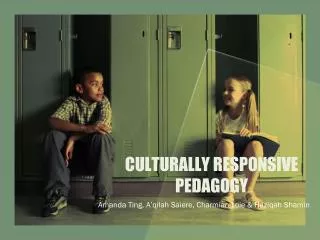
CULTURALLY RESPONSIVE PEDAGOGY Amanda Ting, A’qilah Saiere, Charmian Loie & Haziqah Shamin
What is the first word that comes to your mind when you hear “Culture”?
Responses Interviewees: Ranged from Ages 12 – 60s Singapore, India, Australia, UK, Sweden, Bosnia & Herzegovina, United States of America, Jordan, Turkey, New Zealand and Somalia. Medical, Education, Arts, Engineering, Business, Law, Banking & Humanities industries. Compiled Results: http://www.wordle.net/show/wrdl/5499089/Culturally_Responsive_Pedagogy
Short Clip – Arranged (2007) Synopsis: ARRANGED centers on the friendship between an Orthodox Jewish woman and a Muslim woman who meet as first-year teachers at a public school in Brooklyn. http://www.youtube.com/watch?v=bx4dIXjFuPQ
Definition & Concepts Culturally Responsive Pedagogy: 1. Positive Perspectives on Parents & Families 2. Communication of High Expectations 3. Learning within the Context of Culture 4. Student-Centered Instruction 5. Culturally Mediated Instruction 6. Reshaping the Curriculum 7. Teacher as Facilitators
Becoming a Culturally Responsive Teacher Engage in reflective thinking and writing Explore personal and family histories Acknowledge membership in different groups Learning the history and experiences of diverse groups Visit students’ families and community Develop an appreciation for diversity
Culturally Responsive Instruction Acknowledge students’ differences as well as their commonalities Validate students’ cultural identity in the classroom Educate students’ about the diversity of the world around them Promote equity and mutual respect Assess students’ ability and achievement validly
Culturally Responsive Instruction Foster a positive inter-relationship among students, their families and community Motivate students to be active participant in their own learning Encourage students to think critically Challenge students to strive for excellence as defined by their potential Assist students in becoming and socially and politically conscious
Implications • What are instructions that are not culturally responsive? • When reflecting cultural & linguistic practices & values while focusing on only one group of students. • Implications -> • - Denying other students an equal opportunity to learn.
Links The Magic of Culturally Responsive Pedagogy Culturally Responsive Differentiated Instructional Strategies Video: A Culturally Responsive Pedagogy of relations Culturally responsive pedagogy and assessment in primary science classrooms
References Bennett, M.M. (2008). Understanding the students we teach: Poverty in the classroom. The Clearing House, 81(6), 251-256. Crespo, D. (Director), & Schaefer, S. C. (Director) (2007).Arranged [DVD]. Available from http://www.youtube.com/watch?v=bx4dIXjFuPQ Richards, H. V., Brown, A. F., & Forde, T. B. (2006). Addressing diversity in schools: Culturally responsive pedagogy. Retrieved on 13th July 2012 from http://www.nccrest.org/Briefs/Diversity_Brief.pdf Peterson, J. M., & Hittie, M. M. (2010). Inclusive teaching: The journey towards effective schools for all learners. (2 ed., p. 360). NJ, USA: Pearson Education Inc.