Mercury Program
The Mercury Program, NASA's first human spaceflight effort, launched landmark missions that pushed the boundaries of human exploration. Alan Shepard became the first American in space with a suborbital flight on May 5, 1961, followed by John Glenn, who made history as the first American to orbit Earth on February 20, 1962. The program utilized the Redstone and Atlas rockets and the Mercury Capsule, featuring numerous controls and an escape system for safety. Launching from Kennedy Space Center, these missions paved the way for future advancements in space travel.

Mercury Program
E N D
Presentation Transcript
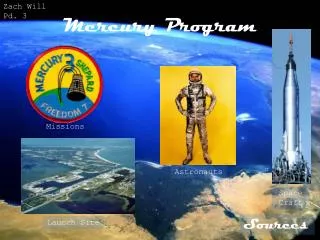
Zach Will Pd. 3 Mercury Program Missions Astronauts Space Craft Sources Launch Site
Astronauts • John Glenn – First American to orbit the earth • Alan Shepard - First American to make a suborbital flight into space. • Virgil Grissom - Second suborbital flight. Spacecraft sank before recovery when hatch unexpectedly blew off. • There was a total of seven but these are the three that made historic firsts. • NASA also used chimpanzees in the Mercury Program Ham the chimp
Alan Shepard • Born November 18, 1923 • Went into space 2 times • Was a test pilot prior to being an astronaut • Commanded the Mercury 3 mission • In the Apollo program was involved in the third lunar landing
John Glenn • Born July 18, 1921 • Was the first American to orbit the earth • Commanded the Mercury 6 mission • Was the Ohio senator from 1974 – 1999 • Went into space for a second time at age 77 and still holds the record for oldest man in space
Missions • Total of 29 missions • First twenty were unmanned • The last nine were manned and three were canceled • Most important Missions • Mercury - Redstone 3 – Alan Shepard made the first suborbital flight for America May 5, 1961 • Mercury-Atlas 6 – John Glenn completed the first American orbit in space. February 20, 1962
Spacecraft • Rockets • Redstone – 83 ft. • Rocket used in the beginning of the program • Atlas – 82 ft. • Rocket used later in the program • Mercury Capsule • One crew member • 1.7 cubic feet of habitable volume • Over 120 controls • Escape system in event of rocket failure
Launch Site • Kennedy Space Center • Cape Canaveral, Florida • Has been the main launch site since 1968 • Opened early in 1961 • Replaced a launch site in Alabama • Is now a popular tourist destination Rocket Launch Video
Sources • Mercury Program. Web. 24 Feb. 2010. <http://www-pao.ksc.nasa.gov/history/mercury/mercury.htm>. • NASA - Home. Web. 23 Feb. 2010. <http://www.nasa.gov/>. • Wikipedia, the free encyclopedia. Web. 23 Feb. 2010. <http://en.wikipedia.org/wiki/Ma in_Page>.