Subject Verb Agreement
80 likes | 192 Vues
Subject-verb agreement is crucial for forming grammatically correct sentences. Ensure that the subject and verb of your sentence agree in number. Singular subjects require singular verbs, while plural subjects need plural verbs. Pay attention to action verbs that may require an additional "s" to ensure agreement. Listening to your sentences can help you determine what sounds correct. In this guide, we provide clear examples and practice exercises to strengthen your understanding of subject-verb agreement. Let's master sentence structure together!


Subject Verb Agreement
E N D
Presentation Transcript
Subject Verb Agreement • The subject in a sentence must agree with the verb in a sentence. • You must decide if the subject is singular or plural. • Then decide if the verb needs to be singular or plural. I disagree! I agree!
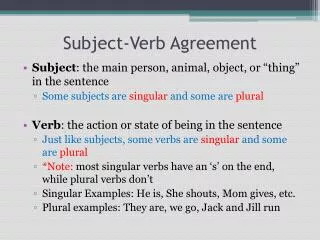
Subject Verb Agreement • How do you make the subject agree with the verb? • If the subject is singular, the verb should be singular. • If the subject is plural, the verb should be plural. • ALSO, if you are using an action verb, you may need to add an s to it to make it agree with the subject. • Tip: Read the sentence to yourself. Usually, you can tell what to write by listening to what sounds right. Plural Verbs are have were Singular Verbs is was has am
Subject Verb Agreement • Examples: • We is a good class. • Oh no! The subject is plural, but the verb is singular! They disagree! • We are a good class. • Yay! The subject is plural, and the verb is plural! They agree!
Subject Verb Agreement • Examples: • She like pizza. • Oh no! The subject and verb do not sound right. They disagree! • She likes pizza. • Yay! The subject and verb sound right! We needed an s. They agree!
Practice! I agree! • I (am, is) 8 years old. • He (have, has) two pencils. • We (is, are) a good class. • She (was, were) late for school. • They (is, are) very funny. • I (are, am) excited! • It (were, was) an easy test.
Practice! I agree! • I (like, likes) pizza. • He (want, wants) another cookie. • We (carries, carry) the boxes. • She (laughs, laugh) very loudly. • They (dance, dances) like a robot. • I (wiggles, wiggle) in my chair. • It (sound, sounds) like a bear!
To agree or not to agree… that is the question.