Exploring Lambda Calculus: Complexity, Evaluation, and Reductions in CS655
In Lecture 6 of CS655 at the University of Virginia, David Evans delves into Lambda Calculus fundamentals, discussing its role in defining integers, evaluating functions, and understanding computation complexity. The lecture emphasizes the concepts of lazy evaluation, special forms, and environment handling in Scheme. Key topics include β-reduction, identity definitions, and practical examples of lambda expressions. This lecture illustrates how simplifications in reductions lead to understanding more about programming language design and the complexity of computation through the lens of lambda calculus.

Exploring Lambda Calculus: Complexity, Evaluation, and Reductions in CS655
E N D
Presentation Transcript
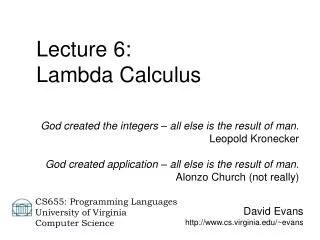
Lecture 6: Lambda Calculus God created the integers – all else is the result of man. Leopold Kronecker God created application – all else is the result of man. Alonzo Church (not really) CS655: Programming Languages University of Virginia Computer Science David Evans http://www.cs.virginia.edu/~evans
English (OED: 500,000 words) C++ (680 pages) Scheme (50 pages) ??? (.5 page) Language Complexity and Brain Cell Decay Language Complexity (Number of Morphemes) 0 5 10 15 20 25 Years Spent in School CS 655: Lecture 6
Complexity in Scheme If we have lazy evaluation, (and don’t care about abstraction) we don’t need these. • Special Forms • if, cond, define, etc. • Primitives • Numbers (infinitely many) • Booleans: #t, #f • Functions (+, -, and, or, etc.) • Evaluation Complexity • Environments (more than ½ of our interpreter) Hard to get rid of? Can we get rid of all this and still have a useful language? CS 655: Lecture 6
-calculus Alonzo Church, 1940 (LISP was developed from -calculus, not the other way round.) term = variable | term term | (term) | variable .term CS 655: Lecture 6
Mystery Function (Teaser) p xy. pca.pca (x.x xy.x) x) y (p ((x.x xy.y) x) (x. z.z (xy.y) y) m xy. pca.pca (x.x xy.x) x) x.x (py (m ((x.x xy.y) x) y)) f x. pca.pca ((x.x xy.x) x) (z.z (xy.y) (x.x)) (mx (f ((x.x xy.y) x))) if x = 0 1 x * f (x – 1) CS 655: Lecture 6
Evaluation Rules -reduction (renaming) y. M v. (M [yv]) where v does not occur in M. -reduction (substitution) (x. M)N M [ xN ] CS 655: Lecture 6
Identity () x y if x and y are same name M1 M2 N1 N2 if M1 N1 M2 N2 (M) (N)if M N x. M y. Nif x y M N CS 655: Lecture 6
Defining Substitution ( ) x [xN] N y [xN] y where x y M1 M2[xN] M1 [xN]M2[xN] (x. M) [xN] x. M CS 655: Lecture 6
Defining Substitution ( ) (y. M) [xN] y. (M [xN]) where x y and y does not appear free in N or x does not appear free in M. (y. M) [xN] z. (M [yz]) [xN] where x y, z x and z y and z does not appear in M or N, x does occur free in M and y does occur free in N. CS 655: Lecture 6
Reduction (Uninteresting Rules) y. M v. (M [yv]) where v does not occur in M. M M M N PM PN M N MP NP M N x. M x. N M N and N P M P CS 655: Lecture 6
-Reduction (the source of all computation) (x. M)N M [ xN ] CS 655: Lecture 6
Recall Apply in Scheme “To apply a procedure to a list of arguments, evaluate the procedure in a new environment that binds the formal parameters of the procedure to the arguments it is applied to.” • We’ve replaced environments with substitution. • We’ve replaced eval with reduction. CS 655: Lecture 6
Some Simple Functions I x.x Cxy.yx Abbreviation for x.(y. yx) CII = (x.(y. yx)) (x.x) (x.x) (y. y (x.x))(x.x) x.x (x.x) x.x = I CS 655: Lecture 6
Evaluating Lambda Expressions • redex: Term of the form (x. M)N Something that can be -reduced • An expression is in normal form if it contains no redexes (redices). • To evaluate a lambda expression, keep doing reductions until you get to normal form. CS 655: Lecture 6
Example f. (( x.f (xx))( x. f (xx))) CS 655: Lecture 6
Alyssa P. Hacker’s Answer ( f. (( x.f (xx))( x. f (xx)))) (z.z) (x.(z.z)(xx))( x. (z.z)(xx)) (z.z) ( x.(z.z)(xx)) ( x.(z.z)(xx)) (x.(z.z)(xx)) ( x.(z.z)(xx)) (z.z) ( x.(z.z)(xx)) ( x.(z.z)(xx)) (x.(z.z)(xx)) ( x.(z.z)(xx)) ... CS 655: Lecture 6
Ben Bitdiddle’s Answer ( f. (( x.f (xx))( x. f (xx)))) (z.z) (x.(z.z)(xx))( x. (z.z)(xx)) (x.xx)(x.(z.z)(xx)) (x.xx)(x.xx) (x.xx)(x.xx) ... CS 655: Lecture 6
Be Very Afraid! • Some -calculus terms can be -reduced forever! • The order in which you choose to do the reductions might change the result! CS 655: Lecture 6
Take on Faith (for now) • All ways of choosing reductions that reduce a lambda expression to normal form will produce the same normal form (but some might never produce a normal form). • If we always apply the outermost lambda first, we will find the normal form is there is one. • This is normal order reduction – corresponds to normal order (lazy) evaluation CS 655: Lecture 6
Who needs primitives? T xy. x F xy. y if pca . pca CS 655: Lecture 6
Evaluation T xy. x F xy. y if pca . pca if T M N ((pca . pca) (xy. x)) M N • (ca . (x.(y. x)) ca)) M N • (x.(y. x))M N • (y. M ))N M CS 655: Lecture 6
Who needs primitives? and xy. ifxyF or xy. ifxTy CS 655: Lecture 6
Coupling [M, N]z.z M N first p.p T second p.p F first [M, N] = p.p T (z.z M N) (z.z M N) T = (z.z M N)xy. x (xy. x) M N M CS 655: Lecture 6
Tupling n-tuple: [M] = M [M0,..., Mn-1, Mn] = [M0,[M1 ,..., [Mn-1, Mn ]... ] n-tuple direct: [M0,..., Mn-1, Mn] = z.z M0,..., Mn-1, Mn Pi,n = x.x Ui,n Ui,n = x0... xn. xi What isP1,2? CS 655: Lecture 6
Primitives What about all those pesky numbers? CS 655: Lecture 6
What are numbers? • We need three (?) functions: succ: n n + 1 pred: n n – 1 zero?: n (n = 0) • Is that enough to define add? CS 655: Lecture 6
Adding for Post-Docs add xy.if (zero? x) y (add (pred x)(succ y) CS 655: Lecture 6
Counting 0 I 1 [F, I] 2 [F, [F, I]] 3 [F, [F [F, I]] ... n + 1 [F, n] CS 655: Lecture 6
Arithmetic Zero? x.x T Zero?0= (x.x T) I = T Zero? 1= (x.x T) [F, I] = F succ x.[F, x] pred x.x F pred 1 = (x.x F) [F, I] = [F, I]F = I = 0 pred 0 = (x.x F) I = IF = F CS 655: Lecture 6
Factorial mult xy.if (zero?x) 0 (addy (mult (predx) y)) fact x. if (zero?x) 1 (multx (fact (predx))) Recursive definitions should make you uncomfortable. Need for definitions should also bother you. CS 655: Lecture 6
Summary • All you need is application and abstraction and you can compute anything • This is just one way of representing numbers, booleans, etc. – many others are possible • Integers, booleans, if, while, +, *, =, <, subtyping, multiple inheritance, etc. are for wimps! Real programmers only use . CS 655: Lecture 6
Charge • Problem Set 2 out today • Make a quantum scheme interpreter • Longer and harder than PS1 • New teams assigned • Read Prakash’s Notes • Be uncomfortable about recursive definitions CS 655: Lecture 6