Changes in Fracture Aperture During Hydraulic Well Tests
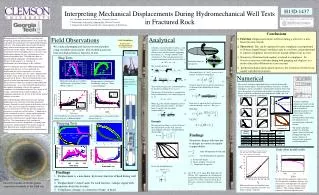
This research explores the dynamic changes in fracture aperture during hydraulic well tests, utilizing field measurements and theoretical modeling. By employing devices such as LVDTs and extensometers, the study measures displacements in hydraulically active sheet fractures. The findings indicate that displacements range from 1-5 mm/m, showcasing the feasibility of analyzing these changes and their implications for storativity, effective aperture, and pressure-sensitive transmissivity in boreholes. The results inform future applications in geomechanics and hydrogeology.

Changes in Fracture Aperture During Hydraulic Well Tests
E N D
Presentation Transcript
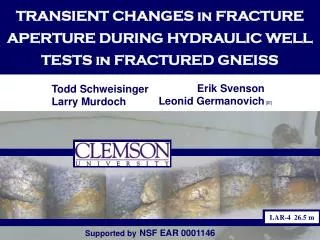
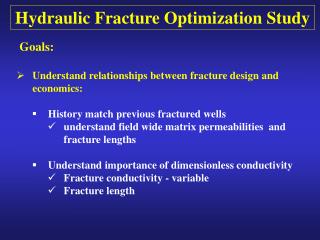
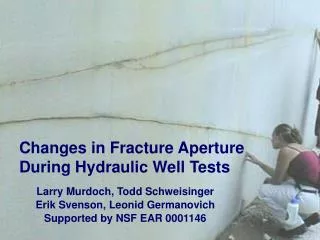
Changes in Fracture Aperture During Hydraulic Well Tests Larry Murdoch, Todd Schweisinger Erik Svenson, Leonid Germanovich Supported by NSF EAR 0001146
Field Measurements • Device • Anchor • LVDT • Reference rod • Function • Change well pressure • Aperture changes • Anchors displace • LVDT signals
Extensometer LR-4
Conditions at field site, Well LR-4 Flowmeter Packer-slug Borehole video Saprolite Frx Frx Depth (m) Frx Gneiss
Vertical Compressibility, Storativity Flowmeter Packer-slug Frx’d Rock Saprolite Frx Frx Depth (m) Frx Sopen hole = 5.0x10⁻⁴ - 7.0x10⁻⁴ Gneiss
d P s P s P s P P p s P P P P d P P s P P P P Theoretical Model P,P:Continuity in finite difference s:Estress-displacement d:Sneddon integral, semi-analytical
Calibration Using Implicit Filtering Kn=1.28x10⁹ (Pa/m); Aperture 283 mm Crossing fracture at 30 m
Conclusions 1. Feasible to measure changes in fracture aperture during hydraulic well tests. • Displacements on the order of 1-5 mm/m • Theoretical analysis capable of predicting observations. • Feasible to invert theoretical analysis using displacement data. Possible applications: Storativity, effective aperture, pressure sensitive transmissivity, locations of crossing fractures.