Sense Perception
This lesson delves into the profound wisdom of perception, inspired by the Chinese proverb, "Two-thirds of what we see is behind our eyes." We explore how our five senses—sight, hearing, touch, taste, and smell—actively shape our understanding of the world. The distinct processes of sensation and perception are analyzed, emphasizing that while our senses provide raw data, our minds interpret and give meaning to our experiences. Through group discussions and reflections on the importance of each sense, we encourage deeper awareness of how we perceive and engage with our surroundings.

Sense Perception
E N D
Presentation Transcript
Sense Perception “Two thirds of what we see is behind our eyes.” Chinese Proverb
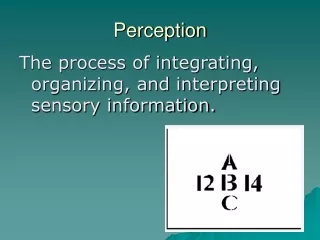
Becoming conscious of our world. • Perceive through the five senses. • Is an active, interpretive, selective process. • SightLight Energy • HearingMechanical Energy • TouchMechanical Energy • Taste Chemical Energy • Smell Chemical Energy
The process…. • Sensation – provided by the world. • Perception – provided by our minds. Group Task If for some reason you had to sacrifice one of your senses, which would you be most willing to lose and which would you be least willing to lose? Give reasons.
Consider these…. • Comments? “The greatest calamity that can befall people is not that they should be born blind, but rather that they should have eyes and yet fail to see.” Hellen Keller “It’s not what you look at that matters, it’s what you see.” Henry David Thoreau “You can’t depend on your eyes when your imagination is out of focus.” Mark Twain
Homework for Tomorrow • Find quotations. Put in journal. • Watch video. See blog entry for link. • Come prepared to discuss the questions linked to the video.