Discrete Event Simulation in Non-Vertebrate Paleontology at the Texas Natural Science Center
180 likes | 310 Vues
This document explores the use of Discrete Event Simulation (DES) in the context of non-vertebrate paleontology, hosted at the Texas Natural Science Center. It details the functionality of DES, its modeling environment using SimPy, and the structured design of models for museum processes. Key components include event handling, resource management, and statistical analysis, enabling researchers to identify bottlenecks and validate model results against actual processes. It emphasizes the importance of DES in enhancing project efficiency and supporting grant applications through rigorous evaluation of workflows.


Discrete Event Simulation in Non-Vertebrate Paleontology at the Texas Natural Science Center
E N D
Presentation Transcript
Discrete EventProcess ModelsandMuseum Curation Louis G. Zachos Ann Molineux Non-vertebrate Paleontology Laboratory Texas Natural Science Center The University of Texas at Austin
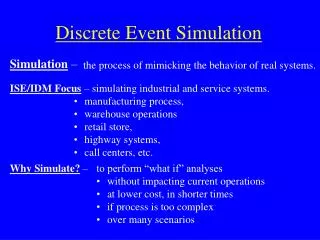
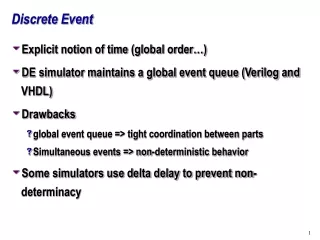
Discrete Event Simulation • What is DES? • Many processes can be represented as a series of discrete events or activities.
Discrete Event Simulation • Events occur at an instant in time, persist for some period of time, and mark a change of state in the process – they are the individual – discrete - steps in the staircase of a process. • DES is a computational (i.e., computer) model of a system of real-life processes modeled as multiple series of discrete events
Functionality of DESModeling Environment • In practical terms, a DES is comprised of a model and the environment in which it is executed • It is possible to design a DES as a single computer program – but there is software to create a modeling environment for a DES
DES Modeling EnvironmentComponents(House-Keeping Functions) • Clock • Random Number Generators for a Variety of Probability Density Functions • Statistics Collation and Graphing Capability • Events, Resources, Stores Lists Handling • Conditions and System State Handling
SimPySimulation in Python • An Open Source object-oriented discrete-event simulation language based on • “Many users claim that SimPy is one of the cleanest, easiest to use discrete event simulation packages!” (from http://simpy.sourceforge.net/) http://simpy.sourceforge.net/
Process Object Model • DES in SimPy is based on the definition of ObjectClasses • There are 3 classes: • Process class – the object that “does something” • Resource class – objects required to “do something” • Monitor class – an object to record information
Model Design • A system can be decomposed in a top-down, hierarchical manner • Start with the most general
Model Design • Break each process into sub-processes
Resources • Resources are things like people, cameras, computer workstations, etc. – required to perform processing.
Stores • The entities being processed – museum specimens – are represented as stores • Stores act like queuing bins -
NPL Model • Photography of type specimens • Scan labels • Prepare and scan • Photograph specimens • Prepare and photograph • Convert raw imagery • Process multi-focus imagery with Helicon • Cleanup and standardize imagery in Photoshop
NPL Model • Resources • People • Cameras • Computer workstations • Stores – fossil specimens and labels • Simplest case – individual resources are alike • Variability is modeled stochastically
Modeling Results Can capture various aspects of a process and realistically model throughput and variability
Modeling Results Bottlenecks in the process become readily apparent – in this example the process waits on human resources – just adding another camera would not improve throughput
Validation • Model results must be validated against actual system throughput • Actual process is timed and variability modeled
Extrapolation • Once a working model has been validated: • Bottlenecks can be quantified • The effects of varying resources or changing order of processes can be evaluated • Reliable estimates of time to completion for entire projects can be made
Conclusion • Discrete event simulations can be a useful tool for evaluating long-term projects in the museum environment • The methodology makes the results easier to justify for budget or grant applications • The development of a model aids in understanding the underlying processes