Launch Vehicles and Orbits
This guide explores the principles behind rocket mechanics and satellite orbits through Newton's Laws of Motion. We learn how rockets and jets operate under the conservation of momentum, driving forces in opposite directions, and how they differ in fuel sourcing. The guide highlights key orbital concepts, including elliptical paths and the balance of inertia and gravity. Historical pioneers of rocketry, from Tsiolkovsky to Goddard, are acknowledged, illustrating advancements in space exploration. Understanding these principles is crucial for comprehending modern aerospace dynamics.

Launch Vehicles and Orbits
E N D
Presentation Transcript
How Rockets Work • Newton's Laws of Motion are: • An object at rest tends to remain at rest • An object in motion tends to remain in motion • For every action there is an equal and opposite reaction
Conservation of Momentum • Newton's Laws are all contained in a more general principle called conservation of momentum. • Momentum is mass times velocity • In a system that is not disturbed from outside, the total momentum stays constant.
Conservation of Momentum Means: • If velocity is zero, momentum is zero (Newton's First Law) • If velocity is not zero, and mass doesn't change, then velocity doesn't change (Newton's Second Law)
Conservation of Momentum and Newton’s Third Law • If mass changes somehow, then so does velocity. • If an object is stationary, and flings off mass, the rest of the mass moves in the opposite direction. • The flung off mass has positive momentum, the rest has negative momentum, and the total momentum remains zero (Newton's Third Law).
Rockets and Jets • Rockets and jets work according to Newton's Third Law. • They fire mass out at high speed and acquire velocity in the opposite direction. • They do not need something to push against. They move because they are expelling exhaust gases at high speeds. • Tthe rocket or jet is pushing mass away, and the mass is pushing back (equal and opposite reaction.)
How Rockets and Jets Differ • Rockets and jets expel mass by burning fuel. • A jet gets the oxygen for combustion from the atmosphere • A rocket carries oxygen in some form with it. • Thus rockets can function outside the Earth's atmosphere; jets can't.
Rockets are Mostly Fuel (and Oxygen) • A rocket or jet has to carry all its remaining fuel with it. (And oxygen, if it’s a rocket). • Most of the mass of the Space Shuttle is fuel, and most of that is used to get the remaining fuel off the ground. • The miles-per-gallon fuel economy of the Space Shuttle in its first foot off the ground is pretty terrible!
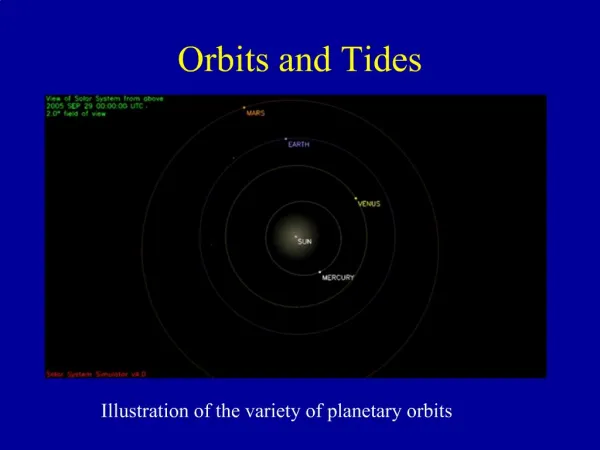
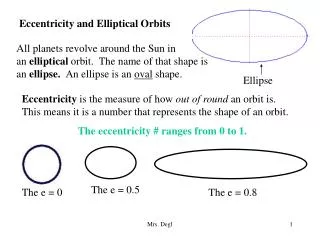
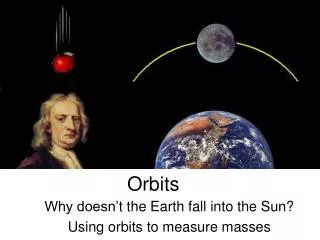
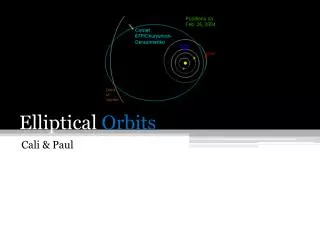
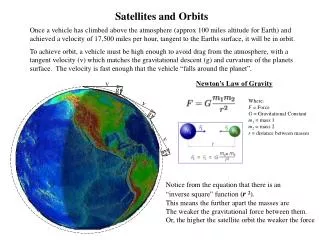
About Orbits and Satellites • Satellites travel elliptical paths with the center of the Earth at one focus (Kepler's First Law) • Inertia causes object to continue moving in a straight line • Gravity pulls object to Earth • Balance between the two = orbit
Important Orbits • Low vs. High Inclination • Almost all are Prograde • Polar Orbits for global coverage • Circular Orbits strongly preferred • Constant altitude • Constant speed • Sun-Synchronous • Geosynchronous • 12-Hour (GPS)
About Orbits • You do not need to expend fuel to stay in orbit • Satellites need attitude control fuel to correct for atmospheric drag, lunar and solar gravity, etc. • May want thrusters to help maintain orbits • Spin stabilization helps • Once below 200 km, atmospheric braking leads to re-entry
About Orbits • The focus of a satellite orbit is the center of the earth • The plane of a satellite orbit always passes through the center of the earth • There is no such thing as an orbit over the poles, over a small region, etc. • It is possible to have an orbit over the equator
Precession • Put sideways force on anything moving in a circle, it will precess • Precession affects planetary rotation • Precession also affects orbits • We can control precession of satellites by selecting orbital inclination • Fixed with respect to stars • Fixed with respect to sun
Three Pioneers of Rocketry • Konstantin Tsiolkovsky (1857-1935) • Worked out theoretical problems of spaceflight • Robert Goddard (1882-1945) • First Liquid Fuel Rocket • Hermann Oberth (1894-1989) • Helped create operational rockets
From Sapwood to Sputnik • An existing rocket, the SS-6, was used. • The warhead section was removed • A cluster of four more SS-6 engines was bolted around a central engine • Very Dependable
Sputnik I • October 4, 1957 • S- (with) + put’ (path) +-nik (one who) =Sputnik • Literally, one who follows the same path
Sensor Technology • Passive (senses only ambient signals) • Active (emits signals) • Imaging • Non-Imaging • Scanning (mechanical or electronic) • Non-scanning
A Noble Myth “In my life, I've seen the images from space of a blue-white-green world — there are no political lines drawn on this planet. • Luis J. Rodriguez “The border between the United States and Mexico is an imaginary line. It cannot be seen from space” • The Border Zone: A History of Trade between the United States and Mexico, Julia Albright; Age of Irony, Winter 2004