Download
1 / 13
130 likes | 232 Vues
Learn about the dual theorems in linear programming, including weak duality, strong duality, and implications for optimal solutions. Understand how primal and dual problems are related and how to determine optimal solutions.

E N D
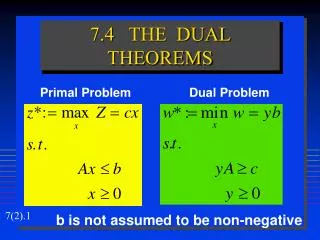
7.4 THE DUAL THEOREMS Primal Problem Dual Problem b is not assumed to be non-negative
7.4.1 Weak Duality Theorem • If x is a feasible solution to the primal problem from (7.13) and y is a feasible solution to the dual problem, then cx £ by. • Proof: If x is a feasible solution to the Primal Problem, then we must have: Ax £ b So, if y is a feasible solution to the Dual Problem, we must have (why?) yAx £ yb
Similarly, if y is feasible for the Dual, then yA ≥ c and therefore (why?) for any feasible solution, x, of the Primal Problem we have yAx ≥ cx It follows then that cx £ by.
This result implies that the optimal objective function values for the primal and dual systems are bounded above and below respectively by the other problem. • What are the implications for the optimal solutions? • We shall deal with this question shortly.
7.4.2 Lemma • If a linear programming problem has an unbounded objective, then its dual problem has no feasible solution. Observation: • It is possible that both the primal and the dual problem are infeasible.
7.4.3 Lemma • Let x* be a feasible solution to the primal problem and y* a feasible solution to the dual. Then cx* = by* implies that x* is an optimal solution for the primal and y* is optimal for the dual. Proof: • From the Weak Duality theorem we have cx £ by hence we also have cx £ by*
for any feasible solution x of the primal and any optimal solution y* of the dual. Thus, for any feasible solution x* of the primal for which cx*=by* we have (why?) cx £ cx* for any feasible solution, x, of the primal. This implis that x* is an optimal solution for the primal.
7.4.4 Strong Duality Theorem • If an optimal solution exists for either the primal or its dual, then an optimal solution exists for both and the corresponding optimal objective function values are equal, namely Z* = w*. • Proof: Bottom Line: Let B-1* be the “optimal” value of B-1 (final tableau) and define: y*:=cBB-1*
Then show that y* is feasible for the dual and y*b = z*. • In view of the Weak Duality Theorem, this will imply that y* is optimal for the dual. • Alternatively, ....... have a look at the tableau itself ....
y = cBB-1 for any simplex tableau not necessarily the final one This is implied by our beloved recipe: r = cBB-1D - c
Important Observations • IN ANY TABLEAU, THE DUAL VARIABLES CORRESPONDING TO THE PRIMAL BASIC FEASIBLE SOLUTION ARE THE REDUCED COSTS FOR THE PRIMAL SLACK VARIABLES. • IN APPLYING THE SIMPLEX METHOD TO THE PRIMAL PROBLEM, WE ALSO SOLVE ITS DUAL.