Download
1 / 23
230 likes | 336 Vues
This lecture on Concurrency Control, presented by Professor Elke A. Rundensteiner, delves into vital concepts such as transactions and their actions, the nature of conflicting actions, and schedule representations in database systems. It distinguishes between serial schedules and non-interleaved transactions by exploring scenarios of conflicting actions. Through practical examples, it demonstrates determining conflict serializability using precedence graphs and highlights the significance of transforming schedules into conflict-equivalent structures. These foundational concepts are critical for ensuring data integrity in concurrent transaction processing.

E N D
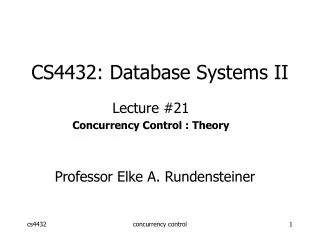
CS4432: Database Systems II Lecture #21 Concurrency Control : Theory Professor Elke A. Rundensteiner concurrency control
Concepts Transaction: sequence of ri(x), wi(x) actions Conflicting actions: read/write on same resource A: r1(A) w2(A) w1(A) w2(A) r1(A) w2(A) Schedule: represents chronological order in which actions are executed Serial schedule: no interleaving of trans/actions concurrency control
A B 25 25 125 250 125 250 250 250 Schedule C T1 T2 Read(A); A A+100 Write(A); Read(A);A A2; Write(A); Read(B); B B+100; Write(B); Read(B);B B2; Write(B); concurrency control
Example: Sc=r1(A)w1(A)r2(A)w2(A)r1(B)w1(B)r2(B)w2(B) Sc’=r1(A)w1(A) r1(B)w1(B)r2(A)w2(A)r2(B)w2(B) T1 T2 concurrency control
Returning to Sc Sc=r1(A)w1(A)r2(A)w2(A)r1(B)w1(B)r2(B)w2(B) T1 T2 T1 T2 no cycles Sc is “equivalent” to a serial schedule, I.e., in this case (T1,T2). concurrency control
A B 25 25 125 250 50 150 250 150 Schedule D T1 T2 Read(A); A A+100 Write(A); Read(A);A A2; Write(A); Read(B);B B2; Write(B); Read(B); B B+100; Write(B); concurrency control
Now for Sd: Sd=r1(A)w1(A)r2(A)w2(A) r2(B)w2(B)r1(B)w1(B) Sd=r1(A)w1(A) r1(B)w1(B)r2(A)w2(A)r2(B)w2(B) T2 T1 concurrency control
Or, let’s try for Sd: Sd=r1(A)w1(A)r2(A)w2(A) r2(B)w2(B)r1(B)w1(B) Sd=r2(A)w2(A)r2(B)w2(B) r1(A)w1(A)r1(B)w1(B) T2 T1 concurrency control
In short, Schedule D cannot be “fixed” : Sd=r1(A)w1(A)r2(A)w2(A) r2(B)w2(B)r1(B)w1(B) • as a matter of fact, there seems to • be no save way to transform this Sd • into an equivalent serial schedule !? concurrency control
For Schedule D: Sd=r1(A)w1(A)r2(A)w2(A) r2(B)w2(B)r1(B)w1(B) T1 T2 T2 T1 T1 T2 Sd cannot be rearranged into serial schedule concurrency control
Idea: Swap non-conflicting operation pairs to see if you can go to a serial schedule. concurrency control
Definition S1, S2 are conflict equivalentschedules if S1 can be transformed into S2 by a series of swaps of non-conflicting actions. concurrency control
Definition A schedule is conflict serializable if it is conflict equivalent to some serial schedule. concurrency control
How determine this ? Answer: A Precedence Graph ! concurrency control
Precedence graph P(S) (S is schedule) Nodes: transactions in S Arcs: Ti Tj whenever - pi(A), qj(A) are actions in S - pi(A) <S qj(A) - at least one of pi, qj is a write concurrency control
Exercise: • What is P(S) forS = w3(A) w2(C) r1(A) w1(B) r1(C) w2(A) r4(A) w4(D) • Is S conflict-serializable? concurrency control
Another Exercise: • What is P(S) forS = w1(A) r2(A) r3(A) w4(A) ? • Is S conflict-serializable? concurrency control
Proof: Assume P(S1) P(S2) Ti: Ti Tj in S1 and not in S2 S1 = …pi(A)... qj(A)… pi, qj S2 = …qj(A)…pi(A)... conflict S1, S2 not conflict equivalent Lemma S1, S2 conflict equivalent P(S1)=P(S2) concurrency control
Note: P(S1)=P(S2) S1, S2 conflict equivalent? concurrency control
Counter example: S1=w1(A) r2(A) w2(B) r1(B) S2=r2(A) w1(A) r1(B) w2(B) Note: P(S1)=P(S2) S1, S2 conflict equivalent concurrency control
Theorem P(S1) acyclic S1 conflict serializable () Assume S1 is conflict serializable Ss: Ss, S1 conflict equivalent P(Ss)=P(S1) P(S1) acyclic since P(Ss) is acyclic concurrency control
Theorem P(S1) acyclic S1 conflict serializable T1 T2 T3 T4 () Assume P(S1) is acyclic Transform S1 as follows: (1) Take T1 to be transaction with no incident arcs (2) Move all T1 actions to the front S1 = ……. qj(A)…….p1(A)….. (3) we now have S1 = < T1 actions ><... rest ...> (4) repeat above steps to serialize rest! concurrency control
Theorem holds: P(S1) acyclic S1 conflict serializable concurrency control