Effects of Carbon Dioxide on BTB Color Change with Elodea
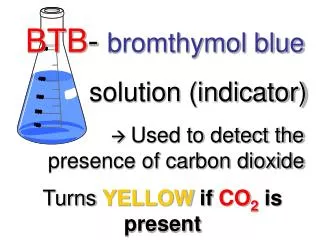
This experiment investigates the interaction between carbon dioxide (CO2) and bromothymol blue (BTB) in the presence of Elodea over one day. After introducing CO2 into BTB, we analyze the impact of a living plant. The procedure includes filling a test tube with BTB, adding CO2 through a straw, and inserting an Elodea sprig, covered with wax. Observations on color changes after 24 hours reveal the effects of photosynthesis, demonstrating the importance of light-dependent reactions and examining the role of BTB as a pH indicator.

Effects of Carbon Dioxide on BTB Color Change with Elodea
E N D
Presentation Transcript
BTB Lab Problem: What happens to BTB with carbon dioxide in it, if elodea is placed in it for 1 day? Background: Hypothesis:
Materials: test tube elodea sprig BTB straw wax film
Procedure: • Fill test tube about ¼ full of BTB. • Gently blow through straw into BTB until it changes color. • Place elodea sprig in test tube. • Cover with wax covering. • Let set overnight.
Data Analysis: 1. What happened to the BTB? 2. Why did this happen? 3. What photosynthesis reaction was responsible for this? (light dependent reaction or Calvin cycle). Explain!
For 3rd hour Data Analysis • What color was the BTB after you blew into it? • What color was it today? • Why did this color change happen? • What do plants use for photosynthesis?