Rhetorical Techniques
Discover the power of rhetorical techniques and figurative language in storytelling and writing. This guide covers essential concepts such as metaphor, personification, simile, allusion, and hyperbole, helping you create vivid imagery and engage your audience effectively. Learn how to employ repetition, alliteration, and onomatopoeia to enhance your prose. Explore various sentence constructions, including periodic sentences, climactic order, and parallel structure, to make your writing more impactful and memorable. Unleash the potential of words for powerful communication!

Rhetorical Techniques
E N D
Presentation Transcript
Rhetorical Techniques Choosing Your Words Carefully
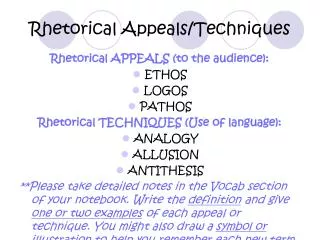
Figurative Language • Meant to create pictures for audience • Metaphor • Personification • Simile • Allusion – Reference to well-known event, person, place or story (i.e. myths, Bible, etc) • Hyperbole • Imagery • Connotation • Analogy – Comparing something unfamiliar to something well-known • Symbol
Word Power • Repetition – Use of same words/phrases multiple times • “It was a strange night, a hushed night, a moonless night.” • Alliteration – Repetition of initial sounds of words • “The monster rambled, raged, and roared.” • Onomatopoeia – A word that sounds like its meaning. • “buzz”, “splash”, “crack”
sentence Construction • Sentence fragment – incomplete thought • “A cold, lonely room. No place to spend twenty years of a life.” • Periodic sentences – withholds the most important point in a sentence to the end. • “Whether playing a young adventurer, a fugitive from the law, or the U.S. president, there is one actor whose films always make money—Harrison Ford.”
sentence Construction • Reversal – repeats words/phrases in reverse order • “Ask not what your country can do for you; ask what you can do for your country.” • Climactic word order – presents multiple facts in order to build to the most important fact. • “The player rose from high school, to college, to the minor leagues, and finally to the major leagues.”
sentence Construction • Abnormal word order – gives variety to writing by changing the usual subject-verb order • “The broken window in which the thieves entered.” • Parallel structure – repeats specific words • “This is a government of the people, by the people, for the people.”
sentence Construction • Understatement (Litotes) – creates the reverse effect (and adds a touch of irony) by making the fact seem less significant. • “Are you aware, Mrs. Bueller, that Ferris does not have what we consider to be an exemplary attendance record?”