Hardware Building Blocks Five Issues Encoding Framing Error Detection Reliable delivery
This comprehensive guide delves into the essential hardware components of networks, outlining key challenges such as encoding, framing, and error detection. It explores various physical transmission mediums—both guided and unguided—and their implications on data delivery reliability. Key concepts like modulation techniques, multiple-access links, and specific encoding methods like NRZ and Manchester are explained. The discussion also includes effective error detection strategies and the impact of modem technologies like ADSL and VDSL on bandwidth and performance, ensuring reliable and secure communications.

Hardware Building Blocks Five Issues Encoding Framing Error Detection Reliable delivery
E N D
Presentation Transcript
Direct Link Networks • Hardware Building Blocks • Five Issues • Encoding • Framing • Error Detection • Reliable delivery • Access Mediation
Building Blocks • Nodes: PC, special-purpose hardware… • hosts • switches • Links (Transmission Media): • Guided: twisted pair, coax cable, optical fiber • Unguided: radio, microwaves, infrared, lasers
Properties of A Link • Frequency • Encoding • Lower layers • modulation • Upper layers • “high” signal • “low” signal • Multiple-access links • How many bit streams can be encoded on it at a given time. • Point-to-point links • Full-duplex • Half-duplex • How can I get one?
Common services available to connect your home Last-Mile Links
1.554 – 8.448 Mbps 16 – 640 Kbps Central Subscriber office premises Local loop ADSL (asymmetric digital subscriber line) STS- N VDSL at 12.96 – 55.2 Mbps Central Neighborhood optical Subscriber office network unit premises over fiber over 1000 – 4500 feet of copper VDSL
ADSL versus Cable • Bandwidth • The number of subscriber • Availability • Security • Reliability
Bits 0 0 1 0 1 1 1 1 0 1 0 0 0 0 1 0 NRZ Encoding • Signals propagate over a physical medium • modulate electromagnetic waves • e.g., vary voltage • Encode binary data onto signals • e.g., 0 as low signal and 1 as high signal • known as Non-Return to zero (NRZ)
Problem: Consecutive 1s or 0s • Long strings of 1s or 0s cause: • baseline wander • Unable to recover clock (clock drift) • Low signal (0) may be interpreted as no signal
Alternative Encodings • Non-return to Zero Inverted (NRZI) • make a transition from current signal to encode a one; stay at current signal to encode a zero • solves the problem of consecutive ones • Manchester • 0 low-to-high transition • 1 high-to-low transition • transmit XOR of the NRZ encoded data and the clock • only 50% efficient (the bit rate = the half baud rate)
Encodings (cont) • 4B/5B (FDDI) • every 4 bits of data encoded in a 5-bit code • 5-bit codes selected to have no more than one leading 0 and no more than two trailing 0s • thus, never get more than three consecutive 0s • resulting 5-bit codes are transmitted using NRZI • achieves 80% efficiency
Bits 0 0 1 0 1 1 1 1 0 1 0 0 0 0 1 0 NRZ Clock Manchester NRZI Encodings (cont)
Bits Node A Adaptor Adaptor Node B Frames Framing • Break sequence of bits into a frame • Typically implemented by network adaptor • Determining where the frame begins and ends
Sentinel Based Approach • Byte-Oriented Protocols • e.g. BISYNC, PPP • problem: special character appears in the data portion • solution: character stuffing • Preceding the ETX with a DLE (data-link-escape) character 8 8 8 8 8 16 STX ETX SYN SYN SOH Header Body CRC
8 16 16 8 Beginning Ending Header Body CRC sequence sequence • Bit-Oriented Protocols • delineate frame with special pattern: 01111110 • e.g., HDLC, SDLC • problem: special pattern appears in the payload • solution: bit stuffing • sender: insert 0 after five consecutive 1s • receiver: delete 0 that follows five consecutive 1s
Counter-based Approaches • Counter-based • include payload length in header • e.g., DDCMP • problem: count field corrupted • solution: catch when CRC fails
Clock-based Approaches • SONET • e.g., SONET: Synchronous Optical Network • each frame is 125-ms long • STS-n (STS-1 = 51.84 Mbps)
Encoding in SONET • NRZ • sender: XOR of the data by the use of a well- known bit pattern (127 bits long). • Receiver: ???
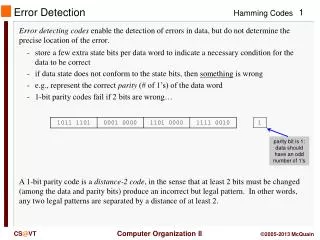
Error Detection • Two-Dimensional Parity • Cyclic-Redundancy Check • Internet Checksum Algorithm
Two-Dimensional Parity Parity bits 0101001 1 1101001 0 1011110 1 Data 0001110 1 0110100 1 1011111 0 Parity 1111011 0 byte
Cyclic Redundancy Check • Add k bits of redundant data to an n-bit message • want k << n • e.g., k = 32 and n = 12,000 (1500 bytes) • Represent n-bit message as n-1 degree polynomial • e.g., MSG=10011010 as M(x) = x7 + x4 + x3 + x1 • Let k be the degree of some divisor polynomial • e.g., C(x) = x3 + x2 + 1
CRC (cont) • Transmit polynomial P(x) that is evenly divisible by C(x) • shift left k bits, i.e., M(x)xk • subtract remainder of M(x)xk / C(x) from M(x)xk • Receiver polynomial P(x) + E(x) • E(x) = 0 implies no errors • Divide (P(x) + E(x)) by C(x); remainder zero if: • E(x) was zero (no error), or • E(x) is exactly divisible by C(x)
Selecting C(x) • All single-bit errors, as long as the xk and x0 terms have non-zero coefficients. • All double-bit errors, as long as C(x) contains a factor with at least three terms • Any odd number of errors, as long as C(x) contains the factor (x + 1) • Any ‘burst’ error (i.e., sequence of consecutive error bits) for which the length of the burst is less than k bits. • Most burst errors of larger than k bits can also be detected • See Table 2.6 on page 102 for common C(x)
Internet Checksum Algorithm • View message as a sequence of 16-bit integers; sum using 16-bit ones-complement arithmetic; take ones-complement of the result. u_short cksum(u_short *buf, int count) { register u_long sum = 0; while (count--) { sum += *buf++; if (sum & 0xFFFF0000) { /* carry occurred, so wrap around */ sum &= 0xFFFF; sum++; } } return ~(sum & 0xFFFF); }
Stop-and-Wait Sender Receiver • Problem: keeping the pipe full • Example • 1.5Mbps link x 45ms RTT = 67.5Kb (8KB) • 1KB frames implies 1/8th link utilization
Sender Receiver … ime T … Sliding Window • Allow multiple outstanding (un-ACKed) frames • Upper bound on un-ACKed frames, called window
£ SWS … … LAR LFS SW: Sender • Assign sequence number to each frame (SeqNum) • Maintain three state variables: • send window size (SWS) • last acknowledgment received (LAR) • last frame sent (LFS) • Maintain invariant: LFS - LAR <= SWS • Advance LAR when ACK arrives • Buffer up to SWS frames
£ RWS … … LFR LAF SW: Receiver • Maintain three state variables • receive window size (RWS) • largest acceptable frame (LAF) • last frame received (LFR) • Maintain invariant: LAF - LFR <= RWS • Frame SeqNum arrives: • if LFR < SeqNum < = LAF accept • if SeqNum < = LFR or SeqNum > LAF discarded • Send cumulative ACKs
Sequence Number Space • SeqNum field is finite; sequence numbers wrap around • Sequence number space must be larger then number of outstanding frames • SWS <= MaxSeqNum-1 is not sufficient • suppose 3-bit SeqNum field (0..7) • SWS=RWS=7 • sender transmit frames 0..6 • arrive successfully, but ACKs lost • sender retransmits 0..6 • receiver expecting 7, 0..5, but receives second incarnation of 0..5 • SWS < (MaxSeqNum+1)/2 is correct rule • Intuitively, SeqNum “slides” between two halves of sequence number space
Concurrent Logical Channels • Multiplex 8 logical channels over a single link • Run stop-and-wait on each logical channel • Maintain three state bits per channel • channel busy • current sequence number out • next sequence number in • Header: 3-bit channel num, 1-bit sequence num • 4-bits total • same as sliding window protocol • Separates reliability from order