3.4-1 Variation
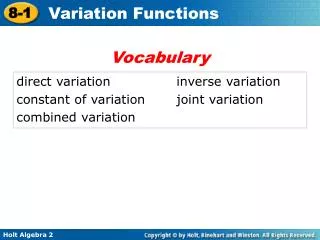
Variation is a fundamental concept in mathematics where one quantity changes in relation to another. This includes direct variation, where one variable changes at a constant rate, inverse variation, where one quantity decreases as another increases, and joint variation, which involves multiple variables. Key examples include Hooke’s Law and various mathematical models indicating the relationships between variables. Understanding these principles allows us to analyze real-world phenomena and solve related problems effectively.

3.4-1 Variation
E N D
Presentation Transcript
Many natural (physical) phenomena exhibit variation = one quantity (quantities) changing on account of another (or several) • Principle is some kind of dependence • What things can we think about that depend on another action/object?
Direct Variation • Direct Variation = as one variable changes, the other changes at some constant rate • Y varies directly with the nthpower of x (y is proportional to the nth power of x) if: • y = kxn • K is a constant; n is a real number • D = rt is an example of direct variation
The constant • In most applications, we have to determine the constant value k, given information about y and x • Example. Hooke’s Law says the force exerted by a spring on a spring scale varies directly with the distance the spring is stretched. If a 15 pound mass suspended on a string stretches the spring 6 inches, how far will a 20 pound mass stretch it?
Example. Hooke’s Law says the force exerted by a spring on a spring scale varies directly with the distance the spring is stretched. If a 15 pound mass suspended on a string stretches the spring 6 inches, how far will a 20 pound mass stretch it? • y = kx
Example. Write the mathematical model for the following statement. • A) S varies directly as the product of 4 and x. • B) Z varies directly with y-cubed. • C) J(x) varies directly with the nth-root of x.
Inverse Variation • Inverse Variation = as one quantity increases, a second quantity decreases • y varies inversely with the nth power of x (or, y is inversely proportional to the nth power of x) if there is a constant k such that • y =
Example. Supper y is inversely proportional to the 2nd power of x, and y = 9 when x = 3. What is y when x = 10? • Example. Supper y is inversely proportional to the square of x, and that y = 5 when x = 2. What is y when x = 10?
Joint Variation • More than 2 variables • Z varies jointly as x and y (proportional to x and y) if there is a constant k such that • Z = kxy • Z varies jointly as the nth power of x and the mth power of y is there is a constant k such that Z = kxnym
Example. Suppose z is jointly proportional to x and y, and that z = 200 when x = 10 and y = 6. What is z when x = -5 and y = 3? • Example. Suppose z is jointly proportional to the square of x and the cube of y, and that z = 500 when x = 2 and y = 27. Find z when x = 16 and y = 32.
Assignment • Pg. 238 • 1-18 all