Implicit model
This paper discusses various implicit data structures, focusing on efficient methods for sorting and searching with optimal time complexity. We explore the implications of using implicit priority queues, branch-free operations on CPU registers, and memory constraints. Essential results from key research are highlighted, including in-place sorting with O(n log n) comparisons and O(n) moves, as well as optimal cache-oblivious dictionaries. The implicit trick for encoding elements is introduced, demonstrating how to achieve fast query performance while managing memory effectively.

Implicit model
E N D
Presentation Transcript
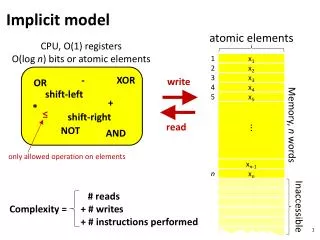
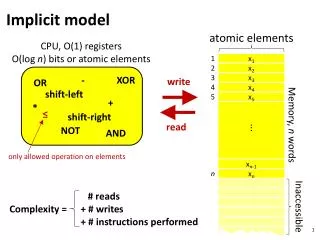
Implicit model atomic elements CPU, O(1) registers O(log n) bits oratomic elements - XOR write OR shift-left + * ≤ shift-right Memory, n words read ... NOT AND onlyallowed operation on elements # reads Complexity = + # writes + # instructionsperformed Inaccessible
Sorting Implicit priorityqueue [G. Franceschini, V. Geffert, An in-place sorting with O(n log n) comparisons and O(n) moves, J.ACM, 52(4), 515-537, 2005] Search trees (no updates) am. [G. Franceschini, R. Grossi, Optimal Cache-Oblivious Implicit Dictionaries, Proc. 30th International Colloquium on Automata, Languages, and Programming, volume 2719 of Lecture Notes in Computer Science, 316-331, Springer-Verlag, 2003.] [G. Franceschini, R. Grossi, J.I. Munro, L. Pagli. ImplicitB-trees: New resultsforthe dictionary problem. IEEE Symposium on Foundations of Computer Science, 145-154, 2002] [G.S. Brodal, R. Fagerberg, R. Jacob, Cache-ObliviousSearchTrees via BinaryTrees of Small Height, 13th Annual ACM-SIAM Symposium onDiscreteAlgorithms, 39-48, 2002]
Thefoundamental implicit trick The relative two elements x < y, canencode a bit = 0 = 1 2log n elements canencodeinteger {0,...,n-1}
Search trees [J. Ian Munro, An Implicit Data Structure Supporting Insertion, Deletion, and Search in O(log² n) Time, Journal of Computer and System Sciences, 33(1), 66-74, 1986] Each nodes stores ..2-1 elements encoding the belowfields (=8∙log n+2) Red-black searchtree x xxxxx x xxxx x xxxxx x x x xxx ps mod s = 0 ps-3 =qs-3 root p2-1 =q2-1 ps qs ps-1 qs-1 ps-2 qs-2 ps-4 qs-4 (2+1)∙logn s ∙ (1 + # size-s-nodes) Total gap: 2+(2-1)+∙ ∙ ∙+
Implicit merging O(n + m) n m canbeused in an implicit O(n∙logn) MergeSort