BALANCING CHEMICAL EQUATIONS
60 likes | 220 Vues
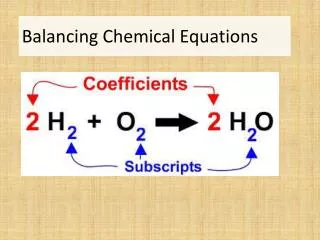
This guide explores the process of balancing the chemical equation SnO2 + H2 → Sn + H2O. It emphasizes the mathematical relationships between reactants and products by identifying unbalanced atoms and placing the appropriate coefficients to achieve balance. The steps included are: 1) Identify which atoms are unbalanced, 2) Use coefficients to balance the equation, and 3) Correct any newly unbalanced reactants or products if necessary. An example balancing to SnO2 + 2H2 → Sn + 2H2O demonstrates the full process.


BALANCING CHEMICAL EQUATIONS
E N D
Presentation Transcript
SnO2 + H2 -> Sn + H2O • Mathematical relationship between the reactants and the products:
SnO2 + H2 -> Sn + H2O • Mathematical relationship between the reactants and the products: • 1) Identify which atoms are not balanced
SnO2 + H2 -> Sn + 2H2O • Mathematical relationship between the reactants and the products: • 1) Identify which atoms are not balanced • 2) Place coefficients to correct and balance
SnO2 + H2 -> Sn + 2H2O • Mathematical relationship between the reactants and the products: • 1) Identify which atoms are not balanced • 2) Place coefficients to correct and balance • 3) Determine and correct, any newly unbalanced reactants &/or products
SnO2 + 2H2 -> Sn + 2H2O • Mathematical relationship between the reactants and the products: • 1) Identify which atoms are not balanced • 2) Place coefficients to correct and balance • 3) Determine and correct, any newly unbalanced reactants &/or products • 4) Correct with coefficient