Understanding and Practicing Second Conditionals in English Grammar
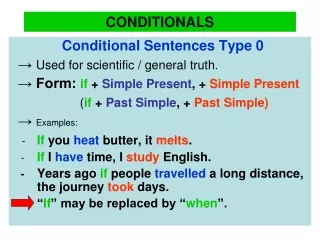
This educational material focuses on the second conditional in English, explaining its use for expressing real and imaginary situations. It outlines key rules, such as the use of the past simple in the if clause and the application of "would," "might," and "could" in the main clause. The resource includes practical exercises to reinforce the learning of second conditionals, allowing learners to fill in blanks and correct verb forms to deepen their understanding. Ideal for English language teachers and students alike.

Understanding and Practicing Second Conditionals in English Grammar
E N D
Presentation Transcript
,,Autorem materiálu a všech jeho částí, není-li uvedeno jinak, je Mgr. Simona PichertováDostupné z Metodického portálu www.rvp.cz ; ISSN 1802-4785. Provozuje Národní ústav pro vzdělávání, školské poradenské zařízení a zařízení pro další vzdělávání pedagogických pracovníků (NÚV).“
Second conditionals Choose the correct words/phrases in these rules. • We use the second conditional to talk about real/imaginary situations. • The second conditional talks about the present or future/the past. • In the if clause/main clause we use the Past Simple. • In the if clause/main clause we use would, ´d, wouldn´t + infinitve.
If I have enough money, I´ll buy a car. If I had enough money, I´d buy a car. 1. Which sentence is a real situation? (the person might buy a car) 2. Which sentence is an imaginary situation? (the person can´t buy a car) We can say If I/he/she/it was … or If I/he/she/it were … in the second conditional.
We can use might + infinitive in the main clause of the second conditional to mean „would perhaps“: If they worked better, they might be more successful. • We can use could + infinitive in the main clause of the second conditional to mean „would be able to“: If we weren´t so busy, we could spend more time together.
Fill in thegapswiththecorrect verb forms. • If I ….. (have) more money, I ….. (buy) a new tablet. • If ….. (not live) wherewe live, we ….. (not be) illsooften. • She ….. (build) more hospitalsifshe ….. (become) the president. • If I ….. (be) you, I ….. (help) him. • Who ….. you (be) ifyou ….. (canbe) anyfamous person? • Ifthe internet ….. (not exist), we ….. (not find) informationsoeasily.
Correctthe verb forms in bold. • If I havetwocomputers, my childrenwouldn´t argue. • Whatwillyou do ifyoudidn´t haveyourfriends? • I wouldhave more timeif I can use my computerwell. • I youstudy more, yourschoolresultswouldbebetter. • Thecomputermightworkproperlyifwerepairit. • Shecan help youifyoutold her aboutit.
Zdroje Vlastní tvorba CUNNINGHAM. Face2face. 2nd ed. Cambridge: Cambridge Univ Press, 2013. ISBN 978-110-7422-100.