African empires
This overview explores the development of Sub-Saharan African civilizations from 600 to 1400 CE. Key events include the establishment of Islam south of the Sahara, Bantu migrations, the rise of the Mali and Songhai Empires, and significant cultural contributions like teracotta and bronze sculptures from Ife. Interactions with neighboring regions through trade, including the Trans-Saharan trade routes, shaped these societies. The influence of oral traditions and the emergence of trade cities reflect the rich tapestry of history, ultimately impacting modern cultures today.

African empires
E N D
Presentation Transcript
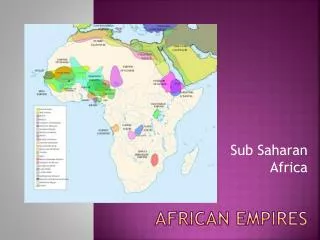
African empires Sub Saharan Africa
General Chronology • 600-700 AD-Ethiopia threatened by Muslims, isolated from Christian Europe • 600-1000 AD Bantu migrations across Sub-Saharan Africa • 1000 AD-Islam established south of Sahara • 1250’s C.E.- Zimbabwes built (stone houses) • 1260 C.E.- Ife Ife (Yoruba) create terra cotta and bronze statues • 1324-25 C.E.- Mansa Musa’s pilgrimage to Mecca • 1400- Swahili cities set up along Indian Ocean coast
Thought Question • Compared to other civilizations we’ve studied, how soon did Africa develop civilizations of its own?
Dates of Major Empires • 1000 AD-Islam established south of Sahara • 1200’s AD- Mali Empire rises • 1400’s A.D.-Songhai Empire rises
Interactions vital to Sub Saharan African Kingdoms • Slow advance of Islam across West Africa • Independence of Ethiopia (NEVER conquered) • Sea trade along East Coast with Islamic Empires and India) • Trans-Saharan trade (including slaves)
Thought Question • What kinds of interactions did Sub-Saharan Africa have with other civilizations?
Art and architecture Djenne, Mali (mosque) Music (communication) Bronze sculpture from Benin Great Zimbabwe
Thought Question • What were some of the major themes seen in early Sub-Saharan African art?
Passing on History in Sub-Saharan AFrica • Most languages derive from Bantu • Few records until after Muslims brought writing to Africa. • Islam INFLUENCED but didn’t REPLACE ancient customs • Griots- storytellers • High social rank • Whole inter-generational groups helped tell stories to pass on history
Connections to today • Cattle = wealth • Lack of written history means that it is harder to study than other civilizations • Slave trade relocated millions of Africans worldwide, also distributed culture • African traditions affect how American culture is transmitted • Islamic influence still evident across Africa
Thought Question • Would you say it is harder or easier to see the influence of Sub-Saharan African civilizations in the world today? Why?