Algebraic Model for Parameterized Shape Editing in 3D Structures
This paper presents an innovative algebraic model designed for parameterized shape editing, facilitating the manipulation of 3D structures composed of regular patterns. By decomposing input shapes into regular patterns and analyzing link relationships, the model allows for high-level shape editing while preserving global characteristics. It employs user-provided constraints to ensure controllability and integrate elastic deformations. Limitations include challenges in handling organic shapes and complex geometries, yet it enables structured transformations that enhance shape control and visualization.

Algebraic Model for Parameterized Shape Editing in 3D Structures
E N D
Presentation Transcript
An Algebraic Model for Parameterized Shape Editing Martin Bokeloh, Stanford Univ. Michael Wand, Saarland Univ. & MPI Hans-Peter Seidel, MPI VladlenKoltun, Stanford University
generating variations of individual shape • Structure-aware deformation Kraevoy et al. 2008 Gal et al 2009. Restricted to deformations with fixed topology
generating variations of individual shape • Structure-aware deformation • Inverse procedural modeling Stava et al. 2010 Bokeloh et al. 2010 Controllability: finding a production of a shape grammar that fits user constraints remains a difficult problem.
generating variations of individual shape • Structure-aware deformation • Inverse procedural modeling • Structure-preserved retargeting Lin et al. 2011 Rely on user-provided constraints, and limited to axis-aligned resizing.
generating variations of individual shape • Structure-aware deformation • Inverse procedural modeling • Structure-preserved retargeting • Pattern-aware shape deformation Bokeloh et al. 2011
Pattern-aware Deformation Model • Calculus of variations: User constraints Elastic energy Continuous patterns Discrete patterns Does not explicitly model the pattern structure of the object but rather uses elastic deformation to adjust patterns locally.
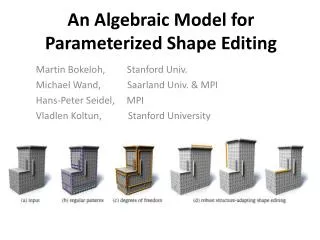
Goal • Parameterize an input 3D structure composed of regular patterns so that high-level shape editing that adapts the structure of the shape while maintaining its global characteristics can be supported.
Manipulating a single regular pattern A regular pattern P(o, l, t) o - origin of the pattern t - translational symmetry l - number of repetitions o n=4 t Manipulations Change l Change t
Parameterizing a structure consists of multiple regular patternsis not easy. (The key: relationships among intersecting patterns)
Algebraic Model = Regular patterns + link analysis Decompose the entire input shape into regular patterns
Algebraic Model = Regular patterns + link analysis Parameterize each regular pattern
Algebraic Model = Regular patterns + link analysis Detect link relationships among regular patterns
Link constraints – pattern constraints • (1-1)-interaction, line to line patch: • Collinear: the overlapping interval. • Intersect: the intersection point. • (1-2)-interaction, line to area patch: • Coplanar: the overlapping interval. • Intersect: the intersection point. • (2-2)-interaction, area to area patch: • Coplanar: the intersection points of the boundaries. • Intersect: (1-1)-interaction . • (0-1)- and (0-2)-interactions with rigid patches: • link the origin of the rigid pattern to the intersection line or surface.
Algebraic Model = Regular patterns + link analysis The complete shape is represented by a linear system.
Algebraic Model = Regular patterns + link analysis The null space of the linear system defines the space of valid variations of the shape.
Shape editing Interactive Constraints: the user selects a pattern element and drags it to a specific target point y. Difference constraints: The user selects two pattern elements , and specifies their difference vector. Regularization constraints: aim to keep the original values of the length variables. Objective function: pattern element closest to the selection point Two pattern elements The diff
Automated visualization of degrees of freedom for test shapes
Limitation • restricted to translational regular pattern • can only handle rigidly symmetric parts, ruling out organic shapes • not consider maintaining irregularity and global symmetries. • Can not handle highly detailed geometry with many interleaving patterns