Understanding Determinants and Cramer’s Rule for Solving Linear Equations
This guide provides essential information on determinants of square matrices, focusing on 2x2 and 3x3 matrices. The determinant for a 2x2 matrix is calculated as det.A = ad - bc, and for a 3x3 matrix, it involves a more complex formula: det.A = (aei + bfg + cdh) - (ceg + afh + bdi). Additionally, we explore Cramer’s Rule, which utilizes determinants to solve systems of linear equations, exemplified through specific equations. Practice problems are included to reinforce understanding.

Understanding Determinants and Cramer’s Rule for Solving Linear Equations
E N D
Presentation Transcript
Determinants Notation: det A |A| Can only be done for SQUARE matrices. (2x2, 3x3, etc.)
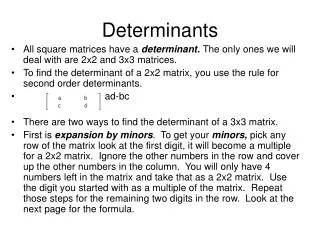
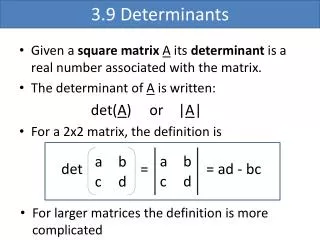
Determinant for 2x2 Matrix det A = ad - bc
Determinant for 2x2 Matrix det A = ad - bc
Determinant for 2x2 Matrix det A = ad - bc det C = 5(3) – 8(2)
Determinant for 2x2 Matrix det A = ad - bc det C = 5(3) – 8(2) = 15 – 16 = -1
Determinant for 3x3 Matrix det A = (aei + bfg + cdh)
Determinant for 3x3 Matrix det A = (aei + bfg + cdh) – (ceg + afh + bdi)
Determinant for 3x3 Matrix det A = (aei + bfg + cdh) – (ceg + afh + bdi) det B =
Determinant for 3x3 Matrix det A = (aei + bfg + cdh) – (ceg + afh + bdi) det B = (1*4*9 + 0*1*6 + 5*2*3)
Determinant for 3x3 Matrix det A = (aei + bfg + cdh) – (ceg + afh + bdi) det B = (1*4*9 + 0*1*6 + 5*2*3) – (6*4*5 + 3*1*1 + 9*2*0)
Determinant for 3x3 Matrix det A = (aei + bfg + cdh) – (ceg + afh + bdi) det B = (1*4*9 + 0*1*6 + 5*2*3) – (6*4*5 + 3*1*1 + 9*2*0) = (36 + 0 + 30) – (120 + 3 + 0)
Determinant for 3x3 Matrix det A = (aei + bfg + cdh) – (ceg + afh + bdi) det B = (1*4*9 + 0*1*6 + 5*2*3) – (6*4*5 + 3*1*1 + 9*2*0) = (36 + 0 + 30) – (120 + 3 + 0) = 66 – 123 = -57
Cramer’s Rule Uses matrices to solve systems of equations. ax + by = e cx + dy = f
Cramer’s Rule Uses matrices to solve systems of equations. ax + by = e cx + dy = f Coefficient Matrix
Cramer’s Rule Uses matrices to solve systems of equations. ax + by = e cx + dy = f Coefficient Matrix
Cramer’s Rule Uses matrices to solve systems of equations. ax + by = e cx + dy = f Coefficient Matrix
Cramer’s Rule Uses matrices to solve systems of equations. ax + by = e cx + dy = f Coefficient Matrix
Cramer’s Rule Uses matrices to solve systems of equations. ax + by = e cx + dy = f Coefficient Matrix
Cramer’s Rule 4x – 2y = -6 -3x + y = -3
Cramer’s Rule 4x – 2y = -6 -3x + y = -3 Coefficient Matrix
Cramer’s Rule 4x – 2y = -6 -3x + y = -3 Coefficient Matrix
Cramer’s Rule 4x – 2y = -6 -3x + y = -3 Coefficient Matrix
Cramer’s Rule 4x – 2y = -6 -3x + y = -3 Coefficient Matrix
Cramer’s Rule 4x – 2y = -6 -3x + y = -3 Coefficient Matrix
Cramer’s Rule 4x – 2y = -6 -3x + y = -3 Coefficient Matrix
Cramer’s Rule 4x – 2y = -6 -3x + y = -3 Coefficient Matrix
Cramer’s Rule 4x – 2y = -6 -3x + y = -3 Coefficient Matrix
Cramer’s Rule 4x – 2y = -6 -3x + y = -3 ( 6 , 15 ) Coefficient Matrix
Practice Find the determinate of the matrix.
Practice Use Cramer’s Rule to solve the system. (I’ve given the determinate to you already.) x – y = 2 2x + 3y = 14