Understanding the 5th Grade Plot Diagram: Key Elements of Story Structure
This guide reviews the essential components of a plot diagram suitable for 5th graders, highlighting the five key elements: Exposition, Inciting Moment, Rising Action, Climax, Falling Action, and Dénouement. It also explains various types of conflict, characterization techniques, points of view, and important literary terms like symbolism, tone, mood, and imagery. By breaking down these concepts, students can enhance their comprehension of storytelling and narrative structure, leading to more effective reading and writing experiences.


Understanding the 5th Grade Plot Diagram: Key Elements of Story Structure
E N D
Presentation Transcript
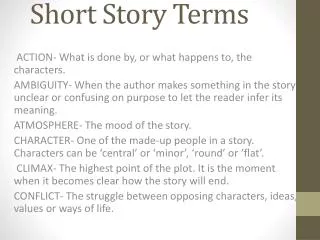
Short story terms A review from 5th Grade
Plot Diagram • Exposition: background information (setting, introduction of characters, etc.) • IncitingMoment: the moment or event that starts the plot moving forward • RisingAction: action leading to the climax • Climax: the turning point • FallingAction: action leading away from the climax, loose ends are tied up • Dénouement: the conclusion
The Plot Diagram Climax FallingAction RisingAction Denouement IncitingMoment Exposition
Types of conflict • Man vs. man • Man vs. nature • Man vs. society (which often includes Man vs. machine) • Man vs. God/supernatural • Man vs. self (Internal Conflict)
Characterization Can Come From… • The character’s physical appearance • The character’s own actions, thoughts and feelings • The thoughts, actions, feelings of a different character toward that character • The narrator’s direct comments about the character
Point of View • First person: the narrator is a character in the story and uses the pronoun “I” • Third-person omniscient: “all knowing” narrator reveals thoughts/feelings of more than one character • Third-person limited: reveals thoughts/feelings of only one character
Literary Terms • Flashback: when a story flashes back to an earlier event to help the reader better understand the current situation • Symbolism: when a character or object stands for more than itself • Setting: where and when the story takes place • Theme: a deeper message that the author is trying to convey to the reader or an idea that the author is exploring in depth.
Literary Terms • Tone: the attitude of the author towards his material • Mood: the atmosphere the author creates • Protagonist: the main character in the story that goes through a change • Antagonist: the character or force that opposes the protagonist • Imagery: vivid descriptions appealing to the five senses
Literary Terms • Personification: giving human traits to inanimate objects • Simile: a comparison of two unlike things using “like” or “as” • Metaphor: a direct comparison of two unlike things • Irony: when one thing is expected but the opposite happens • Foreshadowing: subtle clues that hint at events to come