Strategies for Teaching Students with ADHD: Success in Understanding Word Problems
This document explores various strategies used to support students, particularly those with ADHD and learning difficulties, in mastering word problems. Highlighted experiences include students reading problems aloud, utilizing physical counting tools like fingers and abacuses, and the importance of visual aids and verbalization. Progress reports show that despite challenges, students can gain confidence and make significant advancements in problem-solving skills through tailored teaching methods.

Strategies for Teaching Students with ADHD: Success in Understanding Word Problems
E N D
Presentation Transcript
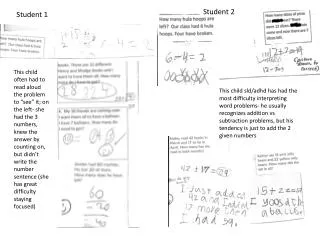
Student 2 Student 1 This child often had to read aloud the problem to “see” it; on the left- she had the 3 numbers, knew the answer by counting on, but didn’t write the number sentence (she has great difficulty staying focused) This child sld/adhd has had the most difficulty interpreting word problems- he usually recognizes addition vs subtraction problems, but his tendency is just to add the 2 given numbers
Solving word problems became easier through the year; he became very confident! Student 3 Below left, I’d corrected the finger numbering the child did, then realized while talking to her that she started with 37, used her 10 fingers to count on to add. Middle: child copied another and wrote “Counted by tens”- she actually ended up using an abacus to add the numbers. Student 4
Student 5 This student made nice progress during the year, having a high degree of success with word problems. Student 6 This student often needed to verbalize the problem- having a drawing was important for him- we also acted out problems frequently.