Download
1 / 31
310 likes | 435 Vues
This blog post discusses the innovative approach to Non-Photorealistic Rendering (NPR), emphasizing its ability to stylize images while sacrificing photorealism. By utilizing a GPU-based backend for efficient image processing, we explore techniques like color simplification, edge enhancement, and quantization. The NPR viewfinder effectively transforms ordinary scenes into artistic interpretations, showcasing its applications in visual communication and augmented reality. Join us as we dive into the details of our NPR algorithm and demonstrate how it can change our perception of the world around us.

E N D
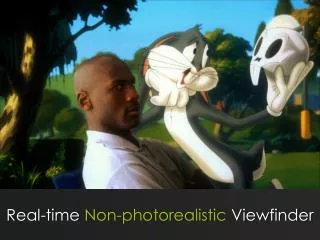
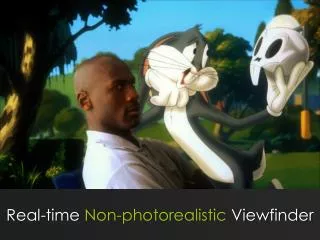
Real-time Non-photorealistic Viewfinder * Tony Hyun Kim and Irving Lin CS478 Computational Photography Dev. blog: cs478.blogspot.com *Raskar, et. al. (2004)
INTRODUCTION: NPR * • Non-photorealistic rendering (NPR), or “stylization,” allows artistic interpretation of an image at the expense of photorealism. • Promotes simplicity and reduction of detail, better emphasizing the semantic content of the image. • Applications: visual communication, augmented virtual reality, image compression. Also, just looks interesting. *Raskar, et. al. (2004)
OUR WORK: TOPICS TO BE DISCUSSED • Demonstration of NPR viewfinder • How it works: • Details of the NPR algorithm • GPU-based “backend” for image processing • Integration with tablet hardware (flash)
HOW IT WORKS NPR algorithm Blah BlahBlah • The world looks “cartoony” with: • Color simplification • Edge enhancement • Color quantization (optional)
HOW IT WORKS NPR algorithm Blah BlahBlah • The world looks “cartoony” with: • Color simplification • Edge enhancement • Color quantization (optional) • Use a bilateral filter: • “Clustering” of nearby pixel colors • Number of approximations available • Separable approx. (Pham, et. al. 2005) • No spatial weight. (Fischer 2006)
HOW IT WORKS NPR algorithm Blah BlahBlah • The world looks “cartoony” with: • Color simplification • Edge enhancement • Color quantization (optional) • Use neighbor gradients: • Just like the sharpness calculation in autofocus routine (“Hello Camera”) • Up-down-left-right gradients
HOW IT WORKS NPR algorithm Blah BlahBlah • The world looks “cartoony” with: • Color simplification • Edge enhancement • Color quantization (optional) • Bucket the pixel value: • Quantization of Y cell-shaded look • Quantization of U,V funny colors
HOW IT WORKS GPU-based backend Blah BlahBlah • NPR algorithm is a sequence of image filters • For example: • Bilateral filtering (multiple rounds) • Edge detection • For performance reasons, we perform all image processing on the GPU • GPU-backend implemented in FCamAppThread
HOW IT WORKS GPU-based backend Blah BlahBlah Inside of FCamAppThread…
HOW IT WORKS GPU-based backend Blah BlahBlah Inside of FCamAppThread… • Get a single 640 x 480 viewfinder frame
HOW IT WORKS GPU-based backend Blah BlahBlah Inside of FCamAppThread… • Copy frame data to “SharedBuffer” • Data is visible to both CPU and GPU
HOW IT WORKS GPU-based backend Blah BlahBlah Inside of FCamAppThread… • Apply sequence of shaders in GPU
HOW IT WORKS GPU-based backend Blah BlahBlah Inside of FCamAppThread… • Copy result back to FCam renderer
HOW IT WORKS GPU-based backend Blah BlahBlah • Typical perf: ~100 ms per frame (10 fps)
FLASH-BASED SELECTIVE NPR No-flash • Request a stream of alternating flash/no-flash video. Steer it to the right destination. • Use flash/no-flash pair to segment foreground and background (very naïve!) Flash
CONCLUSIONS • Demonstration of NPR viewfinder • Stylizes 640 x 480 video at 10 fps • Bilateral filtering, edge detection, quantization • See: cs478.blogspot.com for more results • Backend for GPU-based image processing: • Generic, can be used with other filters • Proof-of-principle integration with hardware • Flash-based, background-selective NPR