Understanding Decimals: Place Value, Comparison, and Basic Arithmetic Operations
This guide focuses on the fundamental concepts of decimals, including place value, comparison, and addition and subtraction. Learn how to identify the value of each digit in a decimal and understand its place—thousandths, hundredths, and tenths. Compare and order various decimal numbers effectively by aligning decimal points and using place value. The guide also explains how to perform basic arithmetic operations with decimals, emphasizing the importance of lining up decimal points and filling in zeros as needed. By mastering these skills, you'll gain confidence in working with decimal numbers.

Understanding Decimals: Place Value, Comparison, and Basic Arithmetic Operations
E N D
Presentation Transcript
Decimals Place counts!
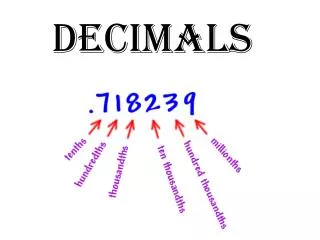
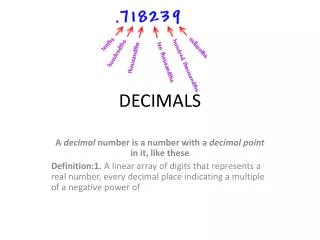
Place Value Place value is the digits “address” in the number.Think about where the digit is placed. • 0.123 • The 1 is in the _____________ place • The 2 is in the _____________ place • The 3 is in the _____________ place
Digit Value Use place value to determine how much the digit is worth. 0.234 • The digit value of the 2 is _____ tenth ______ decimal form _______ fraction form • The digit value of the 3 is _____ hundredths ______ decimal form _______ fraction form • The digit value of the 4 is _____ thousandths ______ decimal form _______ fraction form
Compare and Order Decimals0.1 0.3 0.07 0.009 0.16 0.34 0.075 0.001 0.9 0.1 0.3 0.07 0.009 0.16 0.34 0.075 0.001 0.9 • Line up the decimal points • Fill in with zeros • Compare using place value and put in order Step 1 Step 2 Step 3 0.001 0.009 0.070 0.075 0.100 0.160 0.300 0.340 0.900 0.100 0.300 0.070 0.009 0.160 0.340 0.075 0.001 0.900 Draw a line from Step 2 to Step 3. The first one has been done for you
Decimal form Word form Fraction form 0.001 one thousandths 1 / 1000 0.009 _____________ _______ 0.070 _____________ _______ 0.075 _____________ _______ 0.100 _____________ _______ 0.160 _____________ _______ 0.300 _____________ _______ 0.340 _____________ _______ 0.900 _____________ _______
Decimal form Word form Fraction form 0.001 one thousandths 1 / 1000 0.009 _____________ _______ 0.07 _____________ _______ 0.075 _____________ _______ 0.1 _____________ _______ 0.16 _____________ _______ 0.3 _____________ _______ 0.34 _____________ _______ 0.9 _____________ _______ Are these decimals equivalent to the ones on the previous page? Why or why not? ________________________________________________________________________ ________________________________________________________________________
0.001 0.009 0.07 0.075 0.1 0.16 0.3 0.34 0.9 The first number line is for decimals from 0 to 0.001. The second number line is for decimals from 0 to 0.01 The third number line is for decimals from 0 to 0.1 Where would the first number line be if you could place it on the second number line? Highlight that area on the second line. Where would the second number line be if you could place it on the third number line? Highlight that area on the third line. 0 0.001 0.002 0.003 0.004 0.005 0.006 0.007 0.008 0.009 0.010 0 0.01 0.02 0.03 0.04 0.05 0.06 0.07 0.08 0.09 0.10 0 0.1 0.2 0.3 0.4 0.5 0.6 0.7 0.8 0.9 1.0
a 0.001 b 0.009 c 0.07 d 0.075 e 0.1 f 0.16 g 0.3 h 0.34 i 0.9 Place the decimal numbers on the number lines below using the letter next to each decimal number. The first one has been done for you. a 0 0.001 0.002 0.003 0.004 0.005 0.006 0.007 0.008 0.009 0.010 0 0.01 0.02 0.03 0.04 0.05 0.06 0.07 0.08 0.09 0.10 0 0.1 0.2 0.3 0.4 0.5 0.6 0.7 0.8 0.9 1.0
Adding and Subtracting Decimals • You must add place to place • Line up the decimal points • Fill in with zeros • Add or subtract – regroup if necessary • Bring the decimal point in the sum or difference straight down
Add and Subtractremember to fill in with zeros 2.633 + 0.07 0.8 – 0.04 2.633 + 0.070 2.703 0.80 - 0.04 0.76