Quasi-Rigid Objects in Contact Simulation: Efficient Modeling for Biomedical and Mechanical Applications
290 likes | 417 Vues
This work presents a framework for simulating quasi-rigid objects, which serves as a bridge between rigid body dynamics and fully deformable models. By employing analytical models and linear elasticity principles, we enable efficient contact resolution and collision detection, making it suitable for various applications, including surgery simulation, mechanical design, and computer animation. The methodology emphasizes small deformations and accurate modeling of dynamic contact surfaces, supporting advancements in artificial joints and industrial part wear modeling. Future work includes integrating friction and low-resolution finite element models.


Quasi-Rigid Objects in Contact Simulation: Efficient Modeling for Biomedical and Mechanical Applications
E N D
Presentation Transcript
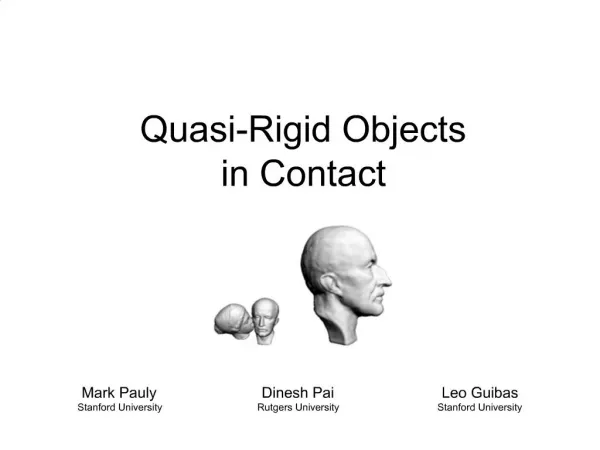
Quasi-Rigid Objects in Contact Mark Pauly Dinesh Pai Leo GuibasStanford University Rutgers University Stanford University
Contacts in Simulation • Bio-medical applications: • surgery simulation • artifical joints, dental implants • Mechanical design: • wear and tear of industrial parts • Physics-based animation: • movies • games
Existing Models • Rigid body dynamics • small number of state variables • efficient collision detection • contact sensitivity problem (a stool with hundreds of legs) • Fully deformable (e.g. FEM, mass-spring) • accurate modeling of complex materials (elasticity, plasticity) • too costly for models that hardly deform
Quasi-Rigid Objects • Physical model • point force applied to object only leads to small, local deformation • analytical system response model to define displacements due to point force • linear elasticity: Global system response by superposition • forces and displacements evaluated on surface only
Quasi-Rigid Objects • Surface model • point cloud representation for modeling consistent, highly dynamic contact surface
Physical Model • Boussinesq approximation • infinite elastic half-space Poisson’s ratio force at x displacement at y due to force at x shear modulus
Physical Model • Boussinesq approximation • system response function
Physical Model • Linear elasticity • superposition total displacement at y
Volume Preservation • Condition:
Discretization • Approximate system response at discrete nodes (point samples) shape function force at node j displacement at node i
Discretization system response matrix vector of tractions [p1,...,pN]T vector of displacements [u1,...,uN]T matrix coefficient
Contact • Collision detection • static bounding volume hierarchies (small deformations) • Contact resolution • compute forces and displacements that resolve contact • Contact surface • find contact surface that is consistent for both models
Contact Resolution • Collision detection determines points that potentially experience displacements (active nodes) • find corresponding point for each active node active nodes corresponding nodes
Contact Resolution • Separation of active nodes • initial separation • final separation
Contact Resolution • Condition for contact resolution: • non-negative separation: si≥ 0 • non-negative force: pi≥ 0
Contact Resolution • Linear Complementarity Problem (LCP) • solved using Lemke’s method
Contact Surface • Consistent conforming contact surface • Adaptive moving least squares (MLS) approximation requires no re-meshing or zippering
Simulation • Treat objects as rigid while in free motion • Integrate contact forces to compute total wrench
Example • Model acquisition • laser-range scan • Hierarchy construction • recursive clustering • efficient multi-level computation
Example • Simulation
Example • Validation Measurement Simulation X2 FootSensor (xSensor Corp.) 37 x 13 sensors, 1.94 sensors/cm2
Bio-medical Applications • Simulate friction effects to predict attrition design of artificial joints
Computer Animation • Quasi-rigid body simulation
Computer Animation • Explicit representation of contact surface allows accurate simulation of friction effects
Computer Animation • Explicit representation of contact surface allows accurate simulation of friction effects
Conclusion • Quasi-rigid objects bridge the gap between rigid bodies and fully deformable models • Simple and efficient model for contact resolution • Limitations: • small deformations • linear elasticity • sharp corners
Future Work • Coupling with low-resolution FEM model • Acquired system response functions • Incorporate friction into LCP • Application: Contact simulation in knee joint
Acknowledgements • NSF grants CARGO-0138456, ITR-0205671, IIS-0308157, EIA-0215887, ARO grant DAAD19-03-1-0331 • Anonymous reviewers