
Advanced NMR Spectroscopy Reveals Kerogen Structural Changes During Thermal Evolution
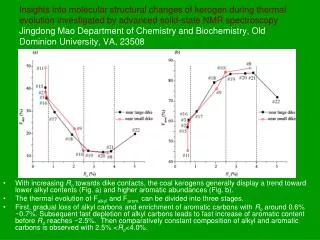
This study investigates the molecular structural changes of kerogen through advanced solid-state NMR spectroscopy, particularly focusing on the thermal evolution of coal kerogens in proximity to dike contacts. As the vitrinite reflectance (Ro) increases, a trend is observed: lower alkyl contents and higher aromatic abundances. The thermal evolution is categorized into three stages: initial gradual loss of alkyl carbons, followed by a rapid depletion leading to increased aromatic content, and finally, a stable composition of alkyl and aromatic carbons as Ro approaches 2.5% to 4%.

Advanced NMR Spectroscopy Reveals Kerogen Structural Changes During Thermal Evolution
E N D
Presentation Transcript
Insights into molecular structural changes of kerogen during thermal evolution investigated by advanced solid-state NMR spectroscopyJingdong Mao Department of Chemistry and Biochemistry, Old Dominion University, VA, 23508 • With increasing Ro towards dike contacts, the coal kerogens generally display a trend toward lower alkyl contents (Fig. a) and higher aromatic abundances (Fig. b). • The thermal evolution of Falkyl and Farom. can be divided into three stages. • First, gradual loss of alkyl carbons and enrichment of aromatic carbons with Ro around 0.6% ~0.7%. Subsequent fast depletion of alkyl carbons leads to fast increase of aromatic content before Ro reaches ~2.5%. Then comparatively constant composition of alkyl and aromatic carbons is observed with 2.5% <Ro<4.0%.