Download
1 / 5
50 likes | 162 Vues
This document outlines the innovative use of Multicast LDP (MLDP) extensions to support hub and spoke multipoint Label Switched Paths (LSP) within MPLS networks, as discussed in draft-jin-jounay-mpls-mldp-hsmp-04. The draft emphasizes new applications, including time synchronization (IEEE1588v2) and IPTV scenarios utilizing HSMP LSP. A novel VPLS implementation is introduced, where P2MP pseudowires are multiplexed to HSMP LSP, streamlining traffic management by reducing broadcast and multicast load while maintaining efficient unicast communication. Future steps include requesting Working Group adoption.

E N D
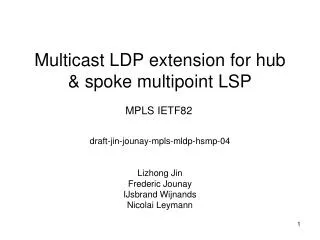
Multicast LDP extension for hub & spoke multipoint LSP MPLS IETF82 draft-jin-jounay-mpls-mldp-hsmp-04 Lizhong Jin Frederic Jounay IJsbrand Wijnands Nicolai Leymann
Update • Have presentation on IETF79 Beijing meeting. • Update section 2: Application.
Applications • Time synchronization based on [IEEE1588v2]. • Typical IPTV scenario could use HSMP LSP for multicast. • P2MP PW with reverse path can multiplex to HSMP LSP. • Newly added application: • VPLS implementation with P2MP PW multiplexed to HSMP LSP.
Applications (cont) • VPLS implementation scenario: • Each P2MP PW is multiplexed to HSMP LSP. • Each PE signals a P2MP PW with itself as a root to all other PEs in the VPLS. • All broadcast/multicast/unknown traffic from this PE will use this P2MP PW. • Unicast traffic from a particular PE to another PE will be sent from leaf to root using the reverse path of P2MP PW. • Advantage: • Reducing traffic utilization from broadcast, multicast and unknown traffic; • Reducing the total number of LSPs maintained by each PE (i.e. instead of requiring a full mesh of PW, now only require one P2MP PW multiplexed to HSMP per PE).
Next steps • Ask WG to adopt this draft. Thank you