Exploring Future Scenarios: Planning for Garden Villages by 2050
This breakout session introduces scenario planning techniques to envision alternative futures for garden villages. Participants will explore the implications of various societal, technological, environmental, political, and economic drivers, imagining what their community could look like in 2050. By engaging in collaborative group tasks, attendees will backcast from the future to identify key elements of their scenarios, assess potential challenges and benefits, and develop spatial plans that enhance local identity and community well-being.

Exploring Future Scenarios: Planning for Garden Villages by 2050
E N D
Presentation Transcript
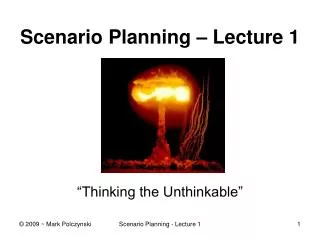
technique to explore, test alternative futures • the future is neutral territory • beyond immediate policy and market horizons • appreciate changes, sequences, decisions • use different ‘drivers’ or perspectives • start in future – say 2040 or 2050 • ‘back cast’ to present • can build robustness into strategies Scenario Planning 2
Confront uncertainty in • Society • Technology • Environment • Politics • Economics Scenario Planning dimensions 3
It is 2050, the GV has been developed, led by your key ‘driver’ theme • Build a plausible scenario embracing • what that might look like • any key elements or features • who and what is there – and anything absent • what are the positive and negative aspects • Give your scenario a name • Describe how you got there Scenario Planning group tasks 4
‘Deep green’ garden village Patrick J Ed P Well connected garden village Jackie C Simon S Strong place identity of garden village Richard BBarbara C Intergenerational, inclusive community Jamie B Jas A Innovation, technology, services Laura P Deb W Enterprising garden village Paul C Joan D Diversity of homes, sizes, tenures Lita K Andrea C Progressive energy garden village Tom E Rob T Healthy lifestyle Tom C Murry B Scenario Planning dimensions 5
Local Eynsham parent - who needs to use facilities in GV • 11 year old twins - who attend new GV school • Retired couple - who downsize move to GV to be near family • Medical practitioner - serving growing population • New start-up digital design business - wants affordable house and workspace • Fabric and furnishings company – serving new/existing households • Cafe owner/operator - independent • Person with disability - affecting their mobility • An occasional cyclist - who could go back to car, but would prefer not to • A GV resident - with workplace in Eynsham • A GV resident - with workplace in Oxford • Recently retried person - with time to contribute to community Addition role play perspectives 6
It is 2050, the GV has been developed, led by your key ‘driver’ theme • Build a plausible scenario embracing • what that might look like • any key elements or features • who and what is there – and anything absent • what are the positive and negative aspects • Give your scenario a name • Describe how you got there Scenario Planning group tasks 7
Broad range of GV facilities, homes, services 4 Gen XYZ 6 Living Lab 9 5 Innovation Farm 8 Gas is gone 7 The bicycle 2 Connect GV 3 Salt Cross 1 Skylark 2050 scenario Attractive, healthy, environment Unattractive, unhealthy environment Narrow range of GV facilities, homes, services 10
Drawing from known assets and scenario implications, develop your spatial ideas, identifying • Aspirations on quality of place – and local place identity • Type & location of local amenities / assets, • Potential walkable neighbourhoods and use locations • Key connections into wider area • Identify green/landscape/open space elements • Start to plot a street/layout structure • (In groups of 8-10 people, facilitated by 2 people - Each group picks a couple of key starting points) Spatial plan thinking 10
What is emerging? • What are key themes? • What are area of agreement? • What areas for more study/design? • What advise for Day 2? Review Plan ideas from Groups 11