Download
1 / 7
70 likes | 195 Vues
This document discusses the implementation of Health Promoting Hospital (HPH) standards within the Piedmont HPH network in Italy. It outlines the regional health service structure, emphasizing the differences in service levels across regions. Since the establishment of the HPH network in 1996, efforts have been made to apply standards across 11 participating hospitals. The results indicate challenges in applying these standards effectively, with many evaluated as only "partly" meeting expectations and a need for a comprehensive regional quality improvement plan.

E N D
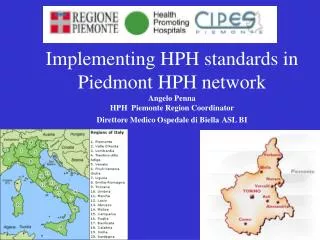
Implementing HPH standards in Piedmont HPH networkAngelo PennaHPH Piemonte Region Coordinator Direttore Medico Ospedale di BiellaASL BI
Implementing HPH standards in Piedmont HPH network: context • The Italian National Health service (SSN) is financed by the general taxation • The SSN is organized autonomously on a regional basis: differences exist in the level of the service offered in the different regions • Piedmont is the region of the north-west of Italy (4.5 milion citizens; Hospitalization Rate 160/1000) • 64 Regional Hospitals: 56 Community Hospitals 8 Teaching Hospitals and H.Trusts • In 1996 an HPH network was established in Piedmont
Implementing HPH standards in Piedmont HPH network: method • 2008 the HPH Coordinating Center (CIPES) translated the “Manual and forms” and invited hospitals to evaluate experimentally standards in one or more departments • 2009 11 Hospitals agreed: 7 Community Hospitals 4 Teaching Hospitals: (1 Children’s and maternity Hospital, 1 Orthopaedic Trauma Hospital)
Implementing HPH standards in Piedmont HPH network: results • A LOT OF STANDARDS EVALUATED AS “PARTLY” • Difficulty to apply the manual in a context of a general hospital • Necessity to evaluate the manual in particular setting of care (chronic disease departments vs acute departments, childern’s department etc.) • Different results from different departments of the same hospital? • In this case, wich is the result? “yes” or “no”? • Is the manual a more usefull instrument for departments than for hospitals? • A RELATIVELY HIGH PERCENTAGE OF STANDARDS EVALUATED AS “NO” • Necessity to better evaluate the poor result’s causes • Necessity to develop a regional quality improvement plan