Ionic Formulas Writing Exercise
Learn to write formulas from ionic compound names. Understand cations and anions, rules for naming, and how to calculate charges to create balanced formulas.

Ionic Formulas Writing Exercise
E N D
Presentation Transcript
How to Write Ionic Formulas In this exercise you will learn to write formulas from the written name of the ionic compound
Ionic compounds consist of: a cation and an anion • Cation = an atom which has lost one or more electrons resulting in a positive charge on the resulting ion • Ex: Na0 → Na1+ + e • Anion = an atom which has gained one or more electrons resulting in a negative charge on the resulting ion • Ex: Cl0 + e → Cl1-
CATIONS • SODIUM chloride , NaCl • The cation is listed first • The cation is named for the element without any change in the name • Ex: Na0 is sodium, the atom • Ex: Na1+ is sodium, the ion • The cation is a metal (exceptions: H1+ and NH41+)
ANIONS (monatomic) • sodium CHLORIDE, NaCl • The anion is listed second • Monatomic anions represent only one element • The anion is named for the element, but the name is changed to end in “-ide” • Ex: Cl0 is chlorine, the atom • Ex: Cl1- is chloride, the ion • The anion is a nonmetal and found directly on the front of the Blue Sheet
ANIONS (polyatomic) • sodium CHLORATE, NaClO3 • The anion is listed second • Polyatomic anions represent more than one element, usually an element and oxygen • The anion is named for the unique element, but ends in “ate” (Some polyatomics have an “ite” form) • Ex: ClO31- is named chlorate after the chlorine; note that the oxygen is not mentioned specifically • NOTE: the name chlorate does not suggest the amount of oxygen present nor the charge on the ion • All the polyatomic ions you will need are listed on the back of the Blue Sheet
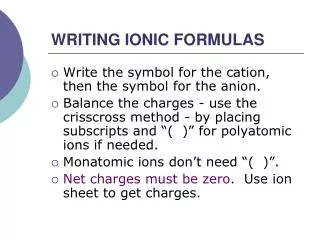
How to write a formula • Sodium chloride • #1 Find sodium on the Blue Sheet • #2 Note its oxidation number (i.e. charge) listed above the symbol (1, which means 1+) • #3 Find chlorine on the Blue sheet • #4 Note its oxidation number (i.e. charge) listed above the symbol (±1, 5, 7) Use only the negative value for the anion. The other values are not used in ionic compounds. • #5 The charges on an ionic compound must add up to zero. SO……………………. Na1+ and Cl1- add up to NaCl • SEE THE NEXT SLIDE FOR EXAMPLES AND SUGGESTIONS
If the two ions involved have different oxidation numbers find a common factor and write them in the correct proportion • Aluminum oxide • Aluminum, Al3+ • Oxide (comes from oxygen), O2- • REMEMBER: the charges must add up to zero! • SO………. two Al3+ gives a six postive charge while three O2- gives a six minus charge • TOGETHER, they are written Al2O3 • Note each subscript represents the number of the element written before it
Other things to consider : #1 The same system of proportions works for polyatomic ions; the total positive charge and total negative charge must add up to ZERO #2 Do NOT change any of the subscripts on the polyatomic ions #3 See the “Rules for Writing Formulas” sheet for rules about using parentheses with polyatomic ions (See Rule 6) #4 See the “Rules for Writing Formulas” sheet for rules about which cations will require Roman numerals (See Rule 7) #5 See the “Rules for Writing Formulas” sheet for rules about the various exceptions to “ide” and “ate” endings and the polyatomic ions that end in “ite” (See Rule 4)