Bacteriophage T4: Structure, Infection Cycle, and Genome Assembly
Bacteriophage T4 is a complex virus characterized by its intricate structure, requiring 20 gene products for assembly. Its capsid contains a linear double-stranded DNA genome, while its tail is composed of a sheath and an internal tube. T4 attaches to E. coli through tail fiber interactions, triggering sheath contraction that injects the genome into the host cell. The replicative cycle involves the production of early, middle, and late mRNA, facilitating phage DNA replication, assembly of phage components, and ultimately lysis of the host cell. Progeny genomes are linked in a concatemer, ensuring functional infection.

Bacteriophage T4: Structure, Infection Cycle, and Genome Assembly
E N D
Presentation Transcript
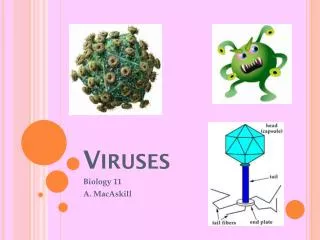
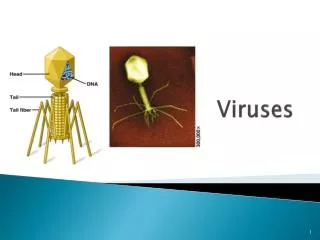
Very complex shape, requiring 20 gene products for assembly - Capsid (head), contains linear dsDNA genome - Tail, consists of sheath plus internal tube Bacteriophage T4 Figure 11.2
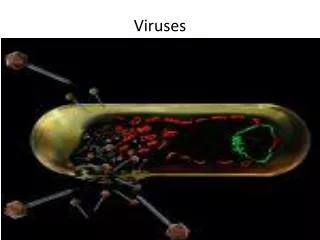
Phage T4 binds to E. coli by contact between its tail fibers and the outer membrane. - A conformational change causes sheath to contract and inject the genome into the cell. Bacteriophage T4 Figure 11.4
Fig. 10-15 Nucleases DNA polymerase New sigma factors Mature phage particle Tail, collar, base plate, and tail fiber proteins Phage head proteins Phage DNA T4 lysozyme production Phage DNA replication Infection Early mRNA Middle mRNA Late mRNA Self assembly Middle proteins Late proteins Early proteins Lysis 0 5 10 15 20 25 Minutes
Progeny genomes are linked in a concatemer. - Cut with an offset, so that individual linear genomes have slight overlaps Figure 11.7
Replicative Cycle of Bacteriophage T4 Figure 11.6
Progeny genomes are linked in a concatemer. - Cut with an offset, so that individual linear genomes have slight overlaps Figure 11.7
Each phage particle is assembled by convergence of three pathways involving head, tail, and tail fibers. Figure 11.8
Replicative Cycle of Bacteriophage T4 Figure 11.6