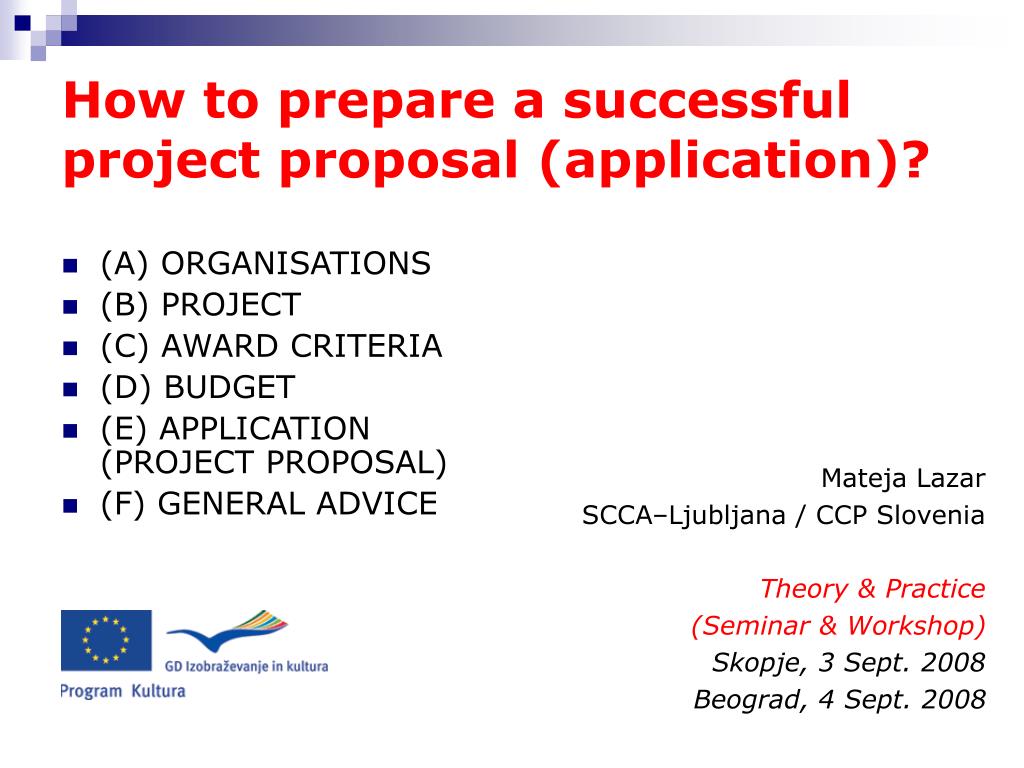
How to prepare a successful project proposal (application)? • (A) ORGANISATIONS • (B) PROJECT • (C) AWARD CRITERIA • (D) BUDGET • (E) APPLICATION (PROJECT PROPOSAL) • (F) GENERAL ADVICE Mateja Lazar SCCA–Ljubljana / CCP Slovenia Theory & Practice (Seminar & Workshop) Skopje, 3 Sept. 2008 Beograd, 4 Sept. 2008
ORGANISATIONSAre organisations (= coord. & co-org.) participating in your project…. 1. … eligible? Only public or private organisations / institutions with a legal status and its core activity in the cultural fieldNOTE: - Open to all non AV cultural sectors and operators, incl. cultural enterprises where they act in a non-profit making cultural capacity. - No longer based on a sectoral approach (as within the previous programmes). Better:interdisciplinary approach if registered in one of the eligible countries: • EU (27) • European Economic Area (Iceland, Liechtenstein, Norway) • Candidate countries (Croatia, Turkey, Macedonia) & Serbia
(A) ORGANISATIONSAre organisations (= coord. & co-org.) participating in your project…. 2. … involved in the design & implementation & funding of the project? MUST be concretely and essentially involved in the design and implementation of the project and contribute financially to the budget of the project! (Quality of partnership) 3. … professionally competent & qualified to complete the proposed activities? operational capacity is verified with the activity reports & CVs and listed experiences in international cultural cooperation
(A) ORGANISATIONSAre organisations (= coord. & co-org.) participating in your project…. 4. … financially stableand have sufficient financial resources to carry out proposed activities and participate in their funding? financial capacity is verified with profit & loss accounts incl. the balance sheets and other obligatory forms to be submitted 5.…bankrupt, guilty of grave professional misconduct or other breaches?
(B) PROJECTAre your project activities.... 1. … eligible? • min./max. duration (eligibility period) • min. no. of organisations & countries involved • non-profit (must not produce a profit), i.e. total income = total costs
(B) PROJECTAre your project activities.... 2. … relevant to the objectives of the CultureProgramme? General objective: • Enhance the European cultural area (European Added Value) …based on a common cultural heritage, through the development of cult.coop. between artists, stakeholders & cult. institutions of the countries taking part in the Programme, with a view to encouraging the emergence of European citizenship Specific objectives: • Promote trans-national mobility of artists and cultural operators • Encourage trans-national circulation of cultural and artistic works and products • Encourage intercultural dialogue
(B) PROJECTAre your project activities.... 3. … linked with »European Years’« theme? • 2008: European Year of Intercultural Dialogue (EYID) • 2009: Year of Creativity and Innovation • 2010: Year for Combating Poverty and Social Exclusion Aim: raising awareness on current topics, exchange of best practices, policy debates…
(B) PROJECTAre your project activities.... 4. …’excellent’? original, innovative, creative with skilled & experienced persons in charge relevant to the target audience (impact on general public; social dimension of activities)
(B) PROJECTAre your project activities.... 5. …contributing to the promotion / impact of the Programme? appropriate media coverage and acknowledgement of the EU grant (visibility & publicity) making the largest possible number of persons benefit from project activities and strengthening their impact (e.g. by producing various materials) - exploitation and dissemination of results
(C) AWARD CRITERIA Check again the award criteria!!! Your project proposal will be evaluated on the basis of award (funding) criteria. Develop your project idea according to the award criteria: 1. European Cultural Added Value (beyond local or regional interests; sth better achieved at European as on national level; more than sum of national activities; inclusion of organisations not previously involved) 2. Relevance to the 3 specific objectives 3. Excellence of proposed cultural activities (level of originality / innovation / creativity, skills & experience of people in charge, relevance to beneficiaries, impact on public, social dimension)
(C) AWARD CRITERIA 4. Quality of partnership (level of co-operation, role & contribution of each partner, consistency between activities/budget/staff; quality of application & budget) 5. Expected level of outputs (no. of beneficiaries, no. of countries hosting or benefiting, trans-sectorial approach) 6. Communication and promotion of activities (visibility of project / quantity of beneficiaries, marketing plan & tools, adequacy of the budget) 7. Sustainability (long-term benefit of the results, potential for continued co-operation & generation of further activities)
(D) BUDGET 1. Eligible budget in Euro requested amount & percentage of the EU support cannot not be higher (or lower) as defined must be balanced (income = expenditure) including only eligible costs: • directly linked with & necessary for the implementation of proposed activities • incurred by the (co-)beneficiary • incurred during the eligibility period • identifiable & verifiable (accounting records!)
(D) BUDGET 2. Secured co-financing by own resources and/or fund-raising (national, regional, local authorities, foundations, sponsors, etc.) must be indicated in the application form and proved in the final report! 3. One EU grant per project! The project may not benefit from other EU funding programme for the same activity.
(E) APPLICATION /PROJECT PROPOSAL Is your application eligible? submitted by the set deadline on the official application form (1 copy) fully and correctly filled in in one of the EU official languages (recommended in EN, FR or DE) including all required annexes & supporting documents & cover letter signed & stamped
(F) GENERAL ADVICE • Before completing the form, read the Programme Guide and study all the original documents! • Respect the rules applied to the call for proposals (deadlines, formal criteria etc.). • Establish solid cooperation between the project partners. • Secure co-financing from other funding sources. • Join or establish contact with European networks. • During preparation of the application consult CCPs! (they exist in every country which participates in the programme)
information & guidance available at the national level in all eligible countries (33) CCP network
CCP network • Promoting the programme • Disseminating information • Facilitating access - advice & assistance in ...... developing projects... searching partners ...
Additional information Cultural Contact Point Slovenia SCCA–Ljubljana, Metelkova 6, Ljubljana Mateja Lazar(ccp@scca-ljubljana.si) www.ccp.si
SCCA, Center for Contemporary Arts – Ljubljana SCCA-Ljubljana (www.scca-ljubljana.si) • a non-governmental and non-profitorganisation based in Ljubljana • core activity in the field of contemporary arts & culture • with activities divided into the following 3 scopes: • PROJECTS: Contemporary art production and research • SCHOOL: Contemporary art education • SERVICE: Information & consultancy
SCCA, Center for Contemporary Arts – Ljubljana (3)SERVICE: • ArtsLink national coordinator (since 2000) • Artservis (since 2001) • CCP Slovenia (since 2002) • Evrokultura(since 2005) • Anna Lindh Foundation national coordinator (since 2008)
ARTSERVIS[www.artservis.org] • Free on-line information resource • [SI, EN]: • for artists, theoreticians, and cultural managers who operate with/in Slovenia or abroad • information on funding sources, opportunities for creative and professional collaboration, and educational programmes • dispatches of new entries on the entire web site (Newsletter)
EVROKULTURA [www.evrokultura.org] Free on-line information resource [SI]: • short information on EU programmes for anybody active within the field of culture • commented links to other informative websites • articles on good practice in Slovenia • reviews of publications and commentaries in the field of EU programmes and cultural policies
GOOD LUCK! SREĆNO! Srečno!